
UPVC pipes vs HDPE pipes both look like similar white or black plastic piping on a construction site, but they behave very differently once buried or pressurised. The short version: UPVC is rigid and cost-effective for standard, structured runs. HDPE is flexible and tougher, built for ground that doesn’t cooperate. Here’s what actually separates them.
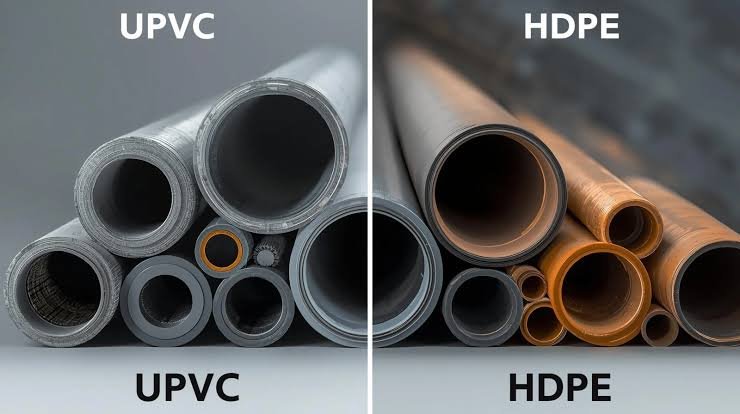
Rigid Versus Flexible: The Core Difference
Nearly every source anchors the whole comparison on this one physical property.
- UPVC is a rigid thermoplastic that holds its shape and needs elbow joints to change direction.
- HDPE is genuinely flexible, bending to a radius of roughly 25 times its own diameter, which lets it curve around obstacles, trees and uneven ground with far fewer fittings.
- That flexibility is why HDPE is consistently recommended for rocky soil, trenchless installation and long pipeline routes where digging a perfectly straight trench isn’t realistic.
- UPVC’s rigidity, by contrast, suits structured, predictable layouts, standard residential plots and building compounds with stable soil.
How Each Pipe Is Actually Joined
The jointing method is a genuinely practical difference, not just a technical footnote.
- UPVC uses solvent cement, a straightforward process needing no special equipment, which keeps small residential plumbing jobs simple and fast.
- HDPE uses heat fusion, either butt fusion or electrofusion, which needs specialised equipment and more skilled labour.
- Fewer joints is one of HDPE’s genuine advantages in long runs, since every joint is a potential leak point, and HDPE’s continuous, weldable lengths cut that risk down meaningfully.
- For a small household underground line, solvent cement’s simplicity makes UPVC the more practical, lower-hassle choice.
Pressure, Impact and Strength
This is where HDPE earns its reputation for toughness, and the direction is consistent across sources.
- HDPE handles higher pressure and significantly more impact before cracking, one source quotes 4-5 times more blunt force resistance than UPVC.
- UPVC is rigid but has a lower pressure tolerance than HDPE, making it better suited to low-pressure water supply and drainage rather than high-pressure distribution.
- HDPE’s flexibility also helps it survive ground movement and tremors better, since it absorbs shock rather than cracking at a rigid joint the way UPVC can.
- For deep or long agricultural and municipal mains specifically, HDPE’s combination of pressure tolerance and flexibility is repeatedly named as the better fit.
Temperature Resistance: A Genuine Source Disagreement
Most sources agree neither pipe is meant for hot water, but one source breaks from that consensus, so it’s worth knowing both views.
- The dominant, India-specific view across multiple sources is that UPVC cannot handle water above 60°C and should never carry hot water.
- One more general source instead claims UPVC handles up to 80°C intermittently while HDPE softens above 60°C, the opposite framing from the India-specific sources.
- Given that Indian plumbing guides consistently reserve hot water for CPVC rather than either UPVC or HDPE, treat UPVC as a cold-water-only material unless your specific pipe’s manufacturer documentation states otherwise.
- HDPE’s comfortable range is generally cited as -40°C to 60°C, making it suitable for buried, outdoor and cold-water applications but not hot water lines.
Cost in India
HDPE consistently costs more upfront, though the gap narrows when you account for fewer joints and leaks over time.
- One India-specific price comparison quotes 20mm uPVC at roughly ₹15-20 per metre against ₹40-45 for HDPE, meaning HDPE can run two to three times the uPVC price per metre.
- HDPE’s installation also needs fusion equipment and more skilled labour, adding further to the upfront cost gap.
- Lifecycle cost tells a more complicated story: one case study of a Kolkata urban water network found HDPE had 37% lower maintenance costs over five years despite an 18% higher initial investment, and fewer leaks overall.
- That kind of lifecycle advantage matters more for large infrastructure projects than for a short residential underground run, where UPVC’s lower upfront cost is harder to beat.
Lifespan
Both pipes last a long time, but the exact figures vary meaningfully by source, so treat any single number as indicative rather than exact.
- UPVC lifespan estimates range from 15-20 years in one India-specific guide to 35-50 years in a broader comparison, a genuinely wide spread.
- HDPE is consistently quoted longer, generally 40-70 years depending on source, with buried, well-installed HDPE networks often cited at the upper end of that range.
- Water quality, UV exposure, burial depth and installation quality all affect real-world lifespan for both materials, so local conditions matter as much as the material choice itself.
Where Each One Actually Gets Used in India
Application, more than any single spec, is what should drive your choice.
- UPVC is the standard for indoor cold water supply, drainage, and short residential underground runs on stable soil, it’s cost-effective and simple to install for exactly these jobs.
- HDPE is favoured for underground mains, rainwater harvesting systems, agricultural water lines, and long outdoor runs, particularly across rocky or uneven terrain.
- For a typical household line running from an overhead tank to the kitchen or a short main supply line into a residential plot, UPVC is generally described as the more practical, cost-effective choice.
- For municipal water projects, large agricultural systems, or any run crossing unstable or rocky ground, HDPE’s flexibility and leak resistance justify its higher cost.
Choosing Between the Two
The decision comes down to terrain, pressure and run length more than brand preference.
- Choose UPVC for standard residential cold water and drainage, short underground runs, and stable soil where cost matters more than flexibility.
- Choose HDPE for long outdoor runs, rocky or uneven terrain, high-pressure agricultural or municipal lines, and anywhere ground movement or earthquake resistance is a real concern.
- Get a local quote for both before deciding on a longer run, since HDPE’s higher upfront cost can be offset by fewer joints and lower long-term maintenance depending on your project’s scale.
FAQs
Q1. Which pipe is better for a short underground water line into my house?
UPVC, for most standard residential situations. It’s simpler to install with solvent cement, costs less per metre, and performs well on short runs over stable soil, which describes most household underground lines.
Q2. Why is HDPE more expensive than UPVC in India?
HDPE costs roughly two to three times more per metre in India, driven by both material cost and the specialised fusion equipment and skilled labour its heat-welded joints require. That higher upfront cost can be offset over time by fewer joints and lower leak rates on long runs.
Q3. Can either UPVC or HDPE carry hot water?
Generally no for either, though sources disagree on the exact threshold. Indian plumbing guides consistently treat both as cold-water materials and reserve hot water lines for CPVC instead, so don’t run hot water through UPVC or HDPE unless your specific product’s documentation explicitly confirms it’s rated for that.
Q4. Is HDPE really more durable than UPVC long-term, or is that just marketing?
The lifespan and leak-rate figures consistently favour HDPE across multiple independent sources, generally 40-70 years against UPVC’s 15-50 year range, plus better impact resistance and fewer joints to fail. One documented case study also found HDPE networks had notably lower maintenance costs over five years despite a higher initial investment, though that scale of benefit applies more to large infrastructure than a small residential line.