
Yes, the MTP kit is legal in India — but with an important condition that trips up a lot of people searching for this answer: it’s legal to obtain and use only with a valid prescription from a registered medical practitioner, following proper medical guidance. The medicine itself isn’t banned or restricted in the way narcotics are, but how you access and use it is what determines whether you’re acting within the law or outside it. Here’s a complete breakdown of what the law actually says, how the process works, and what happens when it’s misused.
The Legal Framework: The MTP Act, 1971 (Amended 2021)
Medical termination of pregnancy in India is governed by the Medical Termination of Pregnancy (MTP) Act, 1971, significantly amended in 2021 to expand access and modernize several provisions. This law has made India’s abortion framework notably progressive by global standards, and it specifically covers both surgical and medical (pill-based) termination methods.
Key features of the current law:
- Abortion is legal up to 20 weeks of pregnancy for women meeting specified criteria (such as contraceptive failure, risk to physical or mental health, or fetal abnormality), and up to 24 weeks in special circumstances — including survivors of rape or incest, minors, and certain vulnerable categories of women — following the 2021 amendment.
- Beyond 24 weeks, termination is permitted only in cases of substantial fetal abnormality, and only after approval from a state-level Medical Board.
- The 2021 amendment replaced “married woman” with “any woman” throughout the Act, extending legal access to unmarried women and those in non-traditional relationships, removing a restriction that had limited access for decades.
- The law guarantees confidentiality — a registered medical practitioner cannot disclose the identity or details of a woman who has undergone MTP, except to someone legally authorized to receive that information. Violating this confidentiality provision is itself a punishable offence under Section 5A of the Act, carrying up to one year of imprisonment and a fine.
What’s Actually in an MTP Kit
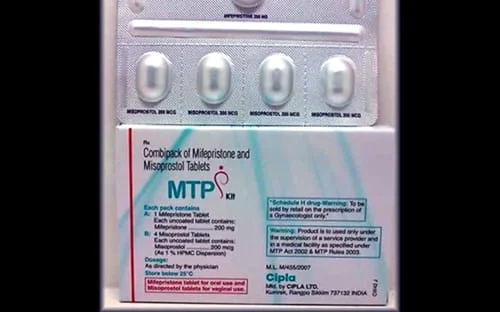
An MTP kit, used specifically for medical (non-surgical) abortion in early pregnancy, typically up to 9 weeks of gestation, contains two types of medication: one tablet of mifepristone (200mg) and a set of misoprostol (200mcg) tablets, usually four. These work in combination, under proper medical protocol, to terminate an early pregnancy without a surgical procedure.
This combination is only approved and intended for use within the gestational window specified by medical guidelines, and its use outside that window, or without proper supervision, carries genuine health risks, including incomplete termination, heavy bleeding, and complications that may require emergency medical intervention.
Why “Legal” Comes With a Condition
Courts in India have repeatedly clarified an important nuance here. The Punjab and Haryana High Court, reiterating earlier precedent, held that the sale of an MTP kit alone does not automatically constitute an offence under the MTP Act — the Act is primarily designed to regulate and restrict the abortion procedure itself to registered practitioners and approved facilities, not to criminalize the existence of the medication.
However, this legal nuance doesn’t mean MTP kits can be freely sold or purchased over the counter. In practice:
- A doctor’s prescription is mandatory. A registered medical practitioner must confirm the pregnancy, assess the gestational age, rule out complications (like ectopic pregnancy), and determine that a medical abortion is medically safe and appropriate before prescribing the kit.
- Selling an MTP kit without a valid prescription is illegal and treated as a violation of the MTP Act, often alongside provisions of the Drugs and Cosmetics Act, since mifepristone and misoprostol are prescription-only drugs.
- Using an MTP kit without medical supervision — bought through informal channels, from an unlicensed seller, or without a doctor confirming details like gestational age — exposes both the buyer and seller to legal risk, and more importantly, exposes the woman to serious, potentially life-threatening medical risk.
This is precisely why enforcement actions do happen. In one recent case covered by regional media, authorities in Haryana seized thousands of MTP kits being sold through an unauthorized supply chain, with the sellers facing charges under Sections 3, 4, and 5 of the MTP Act, alongside investigation under the Drugs and Cosmetics Act. The health department’s concern in such cases isn’t the medicine’s existence, it’s that unsupervised use can lead to incomplete abortions, severe bleeding, infection, and other complications that a woman has no medical support to manage.
The Correct, Legal Way to Access an MTP Kit
If you are considering a medical termination of pregnancy, the legally and medically correct path looks like this:
- Consult a registered gynecologist or medical practitioner. This is the only way to legally obtain a prescription.
- Confirm the pregnancy and its gestational age, typically through an ultrasound, since medical abortion via MTP kit is only appropriate up to roughly 9 weeks (sometimes cited as up to 9-11 weeks depending on clinical judgment).
- Receive the prescription and guidance on administration, including what to expect, warning signs of complications, and a follow-up plan to confirm the termination is complete.
- Purchase the kit from a licensed pharmacy using that prescription, or receive it directly from the prescribing doctor or an approved healthcare facility.
- Follow up with the prescribing doctor after using the medication, since confirmation that the pregnancy has been fully terminated is an essential part of safe medical abortion care.
Registered hospitals and clinics offering MTP services are legally not allowed to turn away a woman who qualifies under the Act’s provisions, and the entire process is meant to be confidential.
What Happens If the Law Is Violated
Unauthorized sale or use of MTP kits — meaning without a valid prescription or outside an approved medical setting — can lead to:
- Prosecution under Sections 3, 4, and 5 of the MTP Act, which govern who may perform terminations and under what circumstances.
- Additional charges under the Drugs and Cosmetics Act, since these medications are classified as prescription drugs that cannot legally be sold without one.
- Legal consequences for both the seller and, in some circumstances, the buyer, depending on the specifics of the case.
- Separately, a breach of the confidentiality provisions under Section 5A can result in up to one year of imprisonment plus a fine, applicable to medical practitioners or facilities that disclose a patient’s abortion-related information without authorization.
Why the Prescription Requirement Exists
It’s worth understanding that this isn’t bureaucratic red tape for its own sake. Medical abortion carries real risks if gestational age is miscalculated, if there’s an undetected ectopic pregnancy, or if the woman experiences a rare but serious complication like excessive bleeding. A doctor’s involvement exists specifically to screen for these risks beforehand and to provide a safety net, including emergency intervention, if something goes wrong afterward. This is also why health authorities actively work to shut down informal, prescription-free sales channels: the concern isn’t that women are accessing legal healthcare, it’s that they’re doing so without the medical safety net the law is designed to guarantee them.
Frequently Asked Questions
Q1. Can I legally buy an MTP kit directly from a pharmacy without seeing a doctor first?
No. Even though the medication itself isn’t illegal, pharmacies cannot legally sell it to you without a valid prescription from a registered medical practitioner, and doing so would violate both the MTP Act and the Drugs and Cosmetics Act.
Q2. Is it illegal for an unmarried woman to get an MTP kit in India?
No. Since the 2021 amendment to the MTP Act, marital status no longer affects eligibility — the law now covers “any woman,” including unmarried women, extending the same legal access that was previously limited to married women.
Q3. What’s the legal gestational limit for using an MTP kit specifically (as opposed to surgical abortion)?
Medical abortion via an MTP kit is generally intended for use up to around 9 weeks of pregnancy, based on medical guidelines; beyond that point, a doctor would typically recommend a surgical method instead, which is permitted under the Act up to 20 weeks (or 24 weeks in specific special circumstances).
Q4. Will my information be kept private if I undergo a medical termination of pregnancy?
Yes. The MTP Act legally mandates confidentiality — a doctor cannot disclose details about a woman’s abortion to anyone without legal authorization, and breaching this is itself a punishable offence carrying up to a year of imprisonment and a fine.