
Plywood vs MDF is one of the most consistently agreed-upon comparisons in this entire series, every source checked lands on the same conclusion: plywood wins on strength and moisture resistance, MDF wins on cost and finish smoothness. The real decision isn’t really which material is “better” overall, it’s matching each one to the specific piece of furniture, and specifically to how much moisture and daily stress that piece will actually face.
What Each Material Actually Is
The construction method explains the strength gap that shows up everywhere else in this comparison.
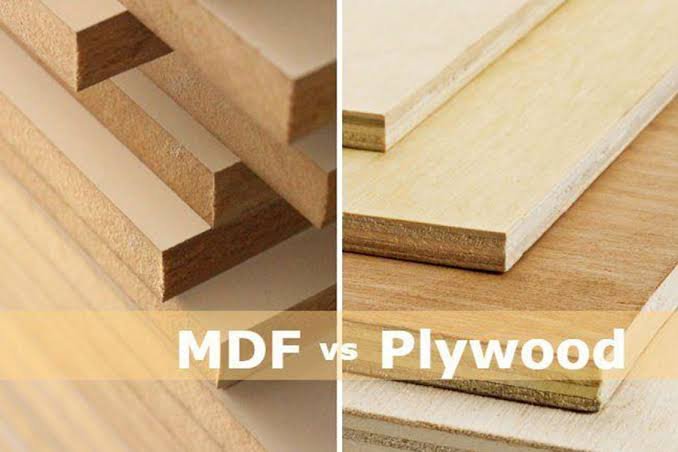
- Plywood is made of multiple thin layers of wood veneer bonded together with glue, with each layer’s grain running in a different direction for strength.
- MDF (Medium-Density Fibreboard) is made from compressed wood fibres bound with resin under heat and pressure, producing a dense, uniform, smooth material rather than visible layers.
- That cross-grain layering is specifically what gives plywood its superior tensile strength and bending resistance, letting it span wider gaps without sagging.
- MDF’s uniform fibre structure is exactly what makes it so smooth and consistent for painting and intricate decorative work, something plywood’s visible grain and layer lines can’t match.
Screw-Holding: Where the Gap Is Widest
This is genuinely the most consistently repeated difference across every source, and it has real practical consequences for furniture that gets opened and closed daily.
- Plywood’s layered construction grips screws excellently, each veneer layer holds the screw independently, and one source puts plywood’s screw-holding capacity at up to twice that of MDF.
- MDF holds screws reasonably well on its face but is genuinely weak at the edges, often needing pilot holes and specific screw types to avoid stripping.
- This matters enormously for wardrobe doors and cabinets specifically, since every open-and-close cycle sends stress directly into the screw fixings holding hinges in place.
- For any furniture with hinges, handles or fittings that get used repeatedly, wardrobes, kitchen cabinets, doors, plywood’s superior screw retention translates directly into fewer loose fittings and fewer repair callbacks over the years.
Moisture Resistance: Plywood’s Clearest Advantage
Every source agrees on this point, with only the exact swelling percentages varying.
- Standard MDF absorbs moisture quickly and swells, one source quotes a 5-8% swell when exposed to moisture, losing strength and structural integrity as it does.
- Plywood’s moisture resistance depends heavily on grade: MR (moisture resistant) is the basic tier, BWR (boiling water resistant) handles regular humidity and splashes well, and BWP or marine grade offers the highest resistance.
- One important nuance worth knowing: BWR plywood is water-resistant, not fully waterproof, and MDF doesn’t match that resistance even when labelled with BWR-style terminology, so don’t assume an MDF product carrying that label performs like genuine BWR plywood.
- Moisture-resistant MDF variants do exist, MR-MDF and HDMR among them, and they perform better than standard MDF, but still generally fall short of BWR or BWP plywood in genuinely humid or wet conditions.
Where Edges Specifically Become the Weak Point
This is a genuinely useful, specific technical detail that several sources flag independently.
- MDF’s exposed edges absorb moisture much faster than its flat face, an unprotected edge near a bathroom-adjacent room can swell within a year.
- This is exactly why edge banding or sealing is described as non-negotiable for MDF furniture, skip it and you’re leaving the material’s weakest point directly exposed.
- Plywood’s layered edges are inherently more resistant to this kind of moisture entry, since each layer provides a partial barrier rather than one continuous absorbent surface.
- If you do choose MDF for any piece, confirming proper edge sealing or lamination during manufacturing matters as much as the core material choice itself.
Cost in India
MDF costs less upfront, consistently and by a meaningful margin, though the full picture is more nuanced.
- One detailed Indian pricing guide quotes 18mm plywood at ₹55-120 per square foot depending on grade, against ₹35-65 for MDF and ₹20-40 for particle board.
- Despite plywood’s higher upfront cost, one source frames it as “the economical one when measured by cost per year” specifically under Indian conditions, high humidity, hot kitchens, monsoon moisture and heavy daily use all favour materials that don’t need early replacement.
- This mirrors the same cost-per-year logic worth applying to the broader solid wood versus engineered wood decision, a cheaper material that needs replacing sooner isn’t necessarily the better financial choice.
- MDF’s lower upfront cost also narrows once you factor in the edge banding, primer and paint it typically needs, costs that plywood doesn’t require to the same degree.
Matching Material to Furniture Type: Where Sources Agree
This is the most practically useful part of the comparison, and the consensus here is genuinely strong.
- Kitchen cabinets and any wet-zone furniture should use BWR or BWP-grade plywood, every source agrees on this without exception, given how much moisture, steam and spillage kitchen furniture faces.
- Wardrobe main structures should be plywood for load and humidity resistance, while wardrobe shutters can go either way, MDF for a smooth painted finish, plywood for a laminate finish, depending on your design preference.
- Children’s furniture should be plywood specifically, since it withstands rough, repeated daily use and impact better than MDF’s more brittle surface.
- Dry, air-conditioned interior spaces, like a guest room closet with light loads and proper edge sealing, are where MDF genuinely makes practical sense as the budget-friendly choice.
Termite Resistance
A smaller but still relevant factor, particularly for ground-level or older furniture in India.
- Plywood’s denser core holds termite-preventive treatment better than MDF’s comparatively softer fibres, giving it a genuine edge in termite-prone regions.
- Treated plywood is generally recommended as the safer choice specifically for ground-level storage or termite-prone areas.
- MDF offers only moderate termite resistance even with treatment, making it a weaker choice where this is a genuine local concern.
Choosing the Right Material
The decision comes down to how much moisture, weight and daily stress the specific piece will face, not a blanket preference for one material.
- Choose plywood for kitchen cabinets, wardrobe structures, children’s furniture, and anything bearing heavy daily use, moisture exposure or repeated hardware stress.
- Choose MDF for dry, low-load interior pieces, decorative painted finishes, and budget-conscious projects where cost matters more than maximum durability.
- Never skip edge sealing on MDF, regardless of where it’s installed, since the edges are consistently its weakest point against moisture.
FAQs
Q1. Is plywood always worth the extra cost over MDF for furniture?
For moisture-prone or heavily used furniture, kitchen cabinets, wardrobes, children’s furniture, yes, since plywood’s longer lifespan under Indian humidity often makes it cheaper per year of actual use despite the higher upfront cost. For dry, low-load interior pieces like a guest room closet, MDF’s lower cost is a genuinely reasonable trade-off.
Q2. Can I use MDF for my kitchen cabinets if I seal the edges properly?
It’s not recommended even with good edge sealing, since kitchen cabinets face continuous heat, steam and spillage that standard or even moisture-resistant MDF struggles with over time. Every source checked recommends BWR or BWP-grade plywood specifically for kitchen and other wet-zone furniture.
Q3. Why does my MDF furniture’s hardware loosen faster than plywood furniture?
MDF holds screws reasonably well on its flat face but is genuinely weak at the edges, often needing pilot holes to avoid stripping, while plywood’s layered construction grips screws through each individual veneer layer. This matters most for frequently used fittings like wardrobe and cabinet hinges, which take repeated stress with every open and close.
Q4. Is BWR-grade plywood actually waterproof?
No, this is a common misconception. BWR (boiling water resistant) plywood resists water and regular humidity well but isn’t fully waterproof, and genuinely waterproof performance requires BWP or marine grade instead. It’s also worth noting that MDF doesn’t match BWR plywood’s moisture resistance even when marketed with similar terminology.