
Plywood vs particle board in humidity isn’t really a close contest, and this is one of the rare comparisons in this series where sources show almost total agreement. Every single source checked, without exception, rates particle board as having the worst moisture resistance of any common engineered wood product, and plywood as the clear, consistent winner once water or sustained humidity enters the picture.
What Each Material Is Actually Made Of
The manufacturing difference directly explains why one survives humidity and the other doesn’t.
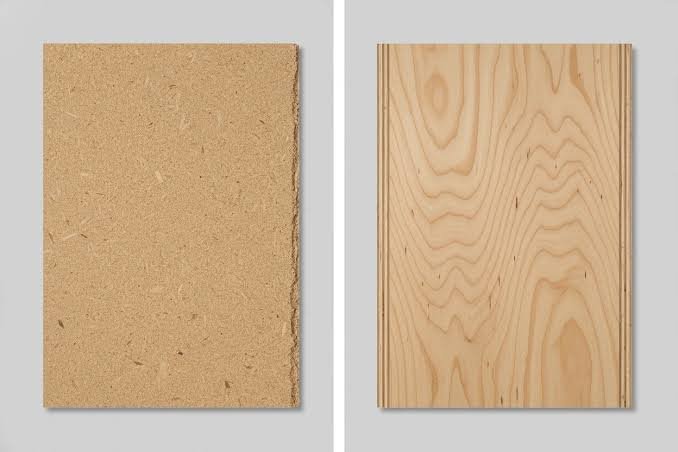
- Particle board is made from wood chips, shavings and sawdust compressed together with resin under heat and pressure, the lowest-density, most budget-oriented engineered wood option available.
- Plywood is built from multiple thin layers of wood veneer bonded together with each layer’s grain running in a different direction, giving it a fundamentally different, more resilient structure.
- That layered construction is specifically why plywood resists quick swelling when humidity changes, while particle board’s loose, pressed composition has far less structural integrity to resist moisture once it gets in.
- This difference in build is the single root cause of everything else in this comparison, strength, screw-holding, lifespan and moisture performance all trace back to it.
Moisture Absorption: An Almost Total Consensus
This is where the comparison stops being close at all.
- Particle board absorbs water fastest among common engineered wood materials and swells, and once swollen, it generally does not recover its original shape or strength.
- Swelling figures vary by source but are consistently severe: one India-specific source quotes standard particle board swelling 10-15% when wet, while another reports over 50% swelling after just a 24-hour soak in humid South Indian conditions.
- One source puts it in genuinely alarming, specific terms for India: particle board furniture may degrade within just 2-3 monsoon seasons if any moisture reaches the core.
- Plywood, particularly BWR and BWP grades using phenolic glues, swells less than 5% after the same 24-hour soak test, a dramatically different outcome from the same moisture exposure.
Lifespan in Indian Conditions
The gap here is consistently large across sources, even accounting for the usual variation in exact figures.
- Particle board lifespan estimates range from 3-7 years in bathroom or humid-exposed settings to 5-8 years in dry indoor conditions.
- Plywood lifespan estimates run from 15-25 years up to 30-50 years or more, depending on grade and exposure, a gap of roughly five to ten times particle board’s expected life.
- One source frames it bluntly for India’s climate specifically: monsoon leaks ruin a significant share of budget furniture, and when they do, particle board warps irreversibly while plywood typically recovers.
- In coastal regions like Kerala or Chennai, salt-laden humidity compounds the problem further, accelerating particle board’s degradation beyond what inland monsoon humidity alone would cause.
Strength and Screw-Holding
Beyond moisture, particle board also falls short on the everyday structural demands furniture actually faces.
- Particle board is lightweight and easy to cut, which suits flat, non-structural applications in genuinely dry environments, but it’s prone to sagging under sustained weight, especially in wardrobes or heavily loaded shelving.
- Screw-holding in particle board is consistently rated poor, screws tend to loosen over time and particularly after any re-tightening, something that matters for cabinet hinges and fittings used daily.
- Plywood’s layered structure grips screws far more reliably and supports genuinely heavy loads, one bathroom-furniture comparison specifically notes plywood can support heavy stone countertops where particle board would sag or fail.
- Termites also tend to favour particle board’s resin-bound composition over plywood’s denser, layered structure, adding yet another durability disadvantage.
Where Particle Board Still Makes Sense
Despite the lopsided comparison, particle board isn’t universally wrong to use, provided you’re honest about its limits.
- It remains genuinely appropriate for temporary or rental furniture, where longevity simply isn’t the priority and replacement is expected anyway.
- Pre-laminated particle board (PLPB) is extremely common in Indian modular furniture specifically because it’s affordable, looks clean, and installs quickly, provided it’s kept in genuinely dry conditions with sealed edges.
- One source flags a genuine consumer trap worth knowing: many modular kitchen companies in India use particle board or MDF for the cabinet carcass to cut costs, worth specifically asking about rather than assuming plywood is used throughout.
- Outside of dry, low-stress, budget-driven situations, every source agrees particle board simply isn’t the right choice where humidity or structural load is a genuine factor.
Making the Right Choice for Humid Conditions
Given how consistent the evidence is here, this decision is more straightforward than most in this series.
- Choose plywood for kitchens, bathrooms, wardrobes, and any furniture in a room with real humidity exposure or sustained structural load, this is the only reliable choice in India’s climate for anything meant to last.
- Choose particle board only for temporary, rental, or genuinely low-stress dry-interior furniture where you’ve accepted a short replacement cycle from the outset.
- Ask directly what material your modular furniture carcass is made from, since particle board is frequently used by default to keep costs down even in kitchens and bathrooms where it genuinely shouldn’t be.
FAQs
Q1. How quickly does particle board actually fail once it gets wet in India’s monsoon climate?
One India-specific source warns it can degrade within just 2-3 monsoon seasons if any moisture reaches the core, and once particle board swells from water exposure, it generally doesn’t return to its original shape or strength. This makes even a single unnoticed leak genuinely risky for particle board furniture.
Q2. Is pre-laminated particle board (PLPB) safe to use in a modular kitchen?
It’s commonly used because it’s affordable and fast to install, but its core limitation remains the same as plain particle board, moisture at unsealed edges or drilled holes can still cause swelling. For kitchen cabinet carcasses specifically facing regular water and steam exposure, plywood, particularly BWR or BWP grade, is consistently recommended as the safer long-term choice.
Q3. Why does particle board lose its shape permanently once it swells, while plywood can recover?
Particle board’s structure is made of compressed wood particles bound with resin, and once that structure absorbs enough water to swell, the compressed bond breaks down irreversibly. Plywood’s layered veneer construction gives it more structural resilience, allowing it to better withstand humidity changes without the same permanent deformation.
Q4. Is it ever reasonable to choose particle board over plywood?
Yes, specifically for temporary or rental furniture, or genuinely dry, low-stress indoor applications where you’ve already accepted a short lifespan in exchange for lower upfront cost. Outside of those specific situations, particularly anywhere facing humidity, moisture, or sustained structural load, plywood is consistently the more durable and ultimately more cost-effective choice over time.