
If food waste were a country, it would rank as the world’s third-largest greenhouse gas emitter, trailing only China and the United States, according to the UN’s own framing of a problem that costs the global economy roughly $1 trillion every single year. With households alone wasting an estimated 1.05 billion metric tonnes of food in 2022, the equivalent of at least one billion meals discarded worldwide every day, understanding exactly how this waste translates into genuine environmental damage reveals why the UN has made food waste reduction a central pillar of its climate strategy.
The Sheer Scale of the Problem
Roughly one-third of all food produced globally for human consumption is wasted, and UNEP’s Food Waste Index Report 2024 puts consumer-level waste specifically, households, food service, and retail combined, at 1.05 billion metric tonnes in 2022 alone, equivalent to about 132 kilograms per person and roughly 19% of all food made available to consumers. That figure covers both edible and inedible parts of discarded food, so it shouldn’t be read as 19% of all edible food being deliberately thrown away, but it still represents a genuinely staggering volume of resources produced, transported, and processed only to end up unused.
Households consistently account for the largest single share of this consumer-level waste, contributing 631 million tonnes, or roughly 60% of the global total in 2022, with food service establishments like restaurants and cafeterias contributing a further 28% (290 million tonnes), and retail supermarkets and stores making up the remaining 12%.
Why Rotting Food Produces Such Potent Greenhouse Gases
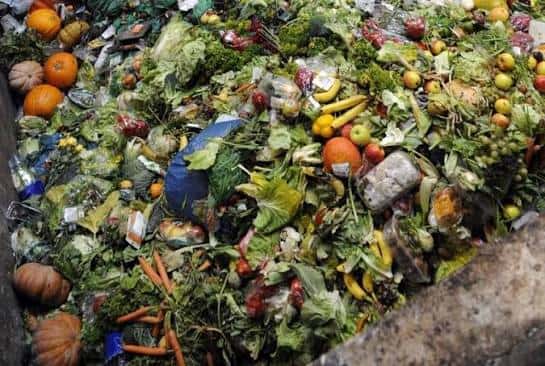
The core environmental mechanism behind food waste’s outsized climate impact comes down to chemistry rather than simple volume. When food waste ends up in a landfill, which it does in the overwhelming majority of cases worldwide, it doesn’t decompose the way it would in open air. Buried under layers of other waste and cut off from oxygen, it undergoes anaerobic decomposition, a slow, oxygen-free breakdown process that produces methane specifically. According to the IPCC, methane is approximately 80 times more potent than carbon dioxide as a greenhouse gas over a 20-year period, making even relatively modest volumes of decomposing food waste genuinely disproportionate contributors to near-term warming.
This isn’t a marginal contribution either. Food waste alone accounts for up to 14% of global methane emissions, and rotting organic waste in landfills, open dumps, and wastewater contributes nearly 20% of all human-caused methane emissions combined. In the United States specifically, the EPA has found that food waste alone drives 58% of all landfill methane emissions, making it the single largest identifiable source within that waste category.
Comparing Food Waste’s Footprint to Other Major Industries
Putting these numbers in context helps illustrate the genuine scale involved. Food loss and waste together generate 8-10% of global greenhouse gas emissions, according to UNEP’s Food Waste Index Report, a figure that is nearly five times the total emissions generated by the entire global aviation industry and notably higher than the entire fashion industry’s carbon footprint. The carbon footprint of food waste specifically has been estimated at roughly 3.3 billion metric tons of CO2 equivalent annually, a volume of emissions that exists purely because resources were consumed to grow, harvest, process, and transport food that was never actually eaten.
Food production as a whole contributes around 26% of global greenhouse gas emissions, meaning the waste component alone, food that never even gets consumed, represents a substantial fraction of that total footprint, resources spent for genuinely zero nutritional benefit.
The Water and Land Resources Wasted Alongside Emissions
Greenhouse gas emissions represent only one dimension of food waste’s environmental cost. The water footprint of global food waste has been estimated at roughly 2.6 trillion cubic metres annually, comparable to the entire annual flow of the Amazon River, reflecting all the irrigation, processing, and cleaning water embedded in food that ultimately goes uneaten. Wasted food accounts for approximately 24-25% of all agricultural water consumption globally, meaning close to a quarter of the water used specifically to grow food never actually nourishes anyone.
Land use tells a similarly stark story. Food that is wasted has occupied roughly 28% of the world’s total agricultural area, land that was cleared, cultivated, and farmed specifically to grow crops that ultimately never reached a plate. Given that agriculture already occupies roughly 50% of the world’s habitable land and accounts for 70% of global freshwater withdrawals, that 28% waste-attributable share represents genuinely enormous unnecessary pressure on already-strained global land and water systems.
A Genuinely Troubling Contradiction
UNEP’s Executive Director Inger Andersen has been direct about the moral and practical absurdity this creates: in a time of accelerating climate change, growing deforestation, water scarcity, and rising food prices, the world cannot afford to waste precious resources growing food that’s never eaten, particularly given food loss and waste’s roughly $1 trillion annual economic cost. That contradiction becomes starker still when set against global hunger figures, since the amount of food lost specifically due to inadequate cold-chain infrastructure alone would be enough to feed an estimated 1 billion people.
Industrialised, high-income countries also waste disproportionately more food per capita than lower-income regions, with industrialised nations wasting almost as much food (222 million tonnes) as the entire net food production of sub-Saharan Africa (230 million tonnes) combined, a genuinely stark illustration of how unevenly this waste is distributed globally.
Genuine Progress Is Possible
It’s worth noting that meaningful reduction isn’t purely theoretical. The UK and Japan have each demonstrated real household food waste reductions, 22% and 53% respectively, showing that coordinated policy, retailer initiatives, and consumer behaviour change can genuinely move these numbers in the right direction rather than treating the current trajectory as inevitable. UNEP has specifically framed reducing food loss and waste as one of the most effective, immediately actionable strategies available for curtailing greenhouse gas emissions, precisely because the interventions required, better storage, improved cold chains, and household behaviour change, are considerably more achievable at scale than many other climate mitigation strategies currently being pursued.
The Bottom Line
Food waste’s environmental impact extends well beyond the obvious waste of resources, generating 8-10% of global greenhouse gas emissions primarily through methane released during anaerobic decomposition in landfills, consuming a water footprint comparable to the entire Amazon River’s annual flow, and occupying roughly 28% of the world’s agricultural land for food that’s never eaten. With households responsible for roughly 60% of consumer-level waste globally, and demonstrated national success stories like Japan’s 53% household waste reduction, the path toward meaningfully reducing this footprint runs through genuinely achievable changes in storage, purchasing habits, and food system infrastructure rather than requiring any single dramatic technological breakthrough.
Frequently Asked Questions
Q1. Why does food waste in landfills produce so much more greenhouse gas than food that decomposes naturally in open air?
A: Landfill conditions bury food waste under other refuse, cutting it off from oxygen, which forces anaerobic decomposition that specifically produces methane, a gas roughly 80 times more potent than CO2 over 20 years, whereas open-air decomposition with oxygen present produces considerably less methane.
Q2. Which stage of the food supply chain contributes the most to global food waste?
A: Households account for the largest single share at roughly 60% of consumer-level food waste globally (631 million tonnes in 2022), followed by food service businesses like restaurants at 28%, and retail stores like supermarkets contributing the remaining 12%.
Q3. Do wealthier countries waste more food than lower-income countries?
A: Per-household waste differs surprisingly little by income level, only about 7 kg per year between high-, upper-middle-, and lower-middle-income countries, but industrialised nations collectively waste nearly as much food in absolute volume (222 million tonnes) as sub-Saharan Africa’s entire net food production (230 million tonnes).
Q4. Have any countries successfully reduced their food waste at a national level?
A: Yes, the UK reduced household food waste by 22% and Japan by an impressive 53%, demonstrating that coordinated retailer, government, and consumer action can meaningfully shift national food waste trends rather than the problem being unavoidable.
Q5. How does food waste’s climate impact compare to other major global industries?
A: Food loss and waste generate 8-10% of global greenhouse gas emissions, nearly five times the total emissions from the entire global aviation industry and higher than the entire fashion industry’s footprint, making it one of the most significant yet often overlooked contributors to global climate change.