
Every city that coal builds has a specific industrial character — self-contained, function-driven, heavily populated relative to its geographic footprint, and economically tied to the single enterprise that defines its reason for existing. Godavarikhani in Peddapalli district of Telangana is exactly this kind of city. Its name says it plainly: Godavari Khani means Godavari Mine — named after the River Godavari and the coal mines that have been extracting the fuel powering India’s thermal power stations since the Singareni Collieries Company Limited (SCCL) began operations in this belt. With a population of over 229,000, it is one of Telangana’s most populous cities without district headquarters status, sitting within the Ramagundam Municipal Corporation zone.
The TGSRTC bus station at Godavarikhani, in the Kalyan Nagar area near the traffic police station, is the primary public transport hub for this mining city’s daily mobility. Passenger reviews consistently note its significance as a regional hub — 2,000 to 5,000 daily commuters use the station, with frequent buses to Hyderabad and Karimnagar serving the working population’s needs. Parking facilities and an auto-rickshaw stand are available. A noted limitation is that the railway station and bus station are not co-located — they are at a distance from each other requiring auto-rickshaw transfer, unlike many UP or Gujarat district towns where the two are adjacent. Food facilities at the bus station are also limited according to user reviews.
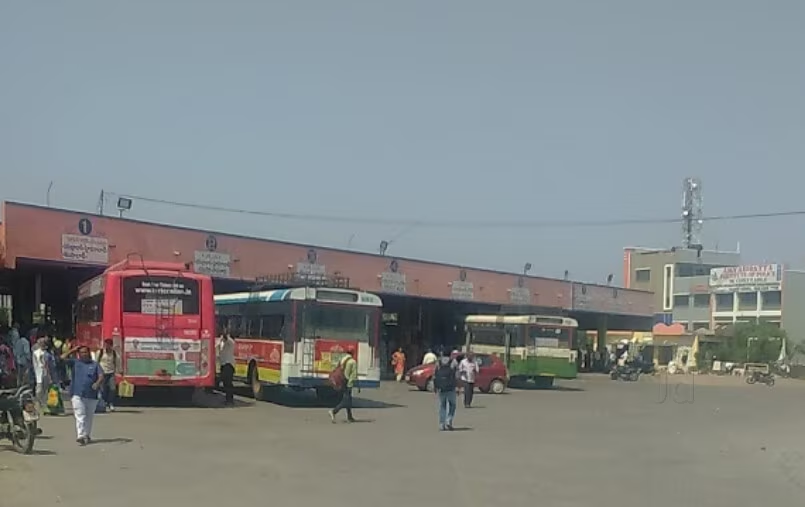
Overview Table
| Detail | Information |
| Name | Godavarikhani Bus Station (TGSRTC) |
| Location | Kalyan Nagar, Godavarikhani, Peddapalli District, Telangana — 505209 |
| Nearby Landmark | Near Traffic Police Station, Main Road, Kalyan Nagar |
| Operated By | TGSRTC |
| Daily Passengers | Approx. 2,000–5,000 |
| Key Routes | Hyderabad (MGBS and JBS), Karimnagar, Ramagundam, Peddapalli, Warangal |
| District | Peddapalli, Telangana |
| Part of | Ramagundam Municipal Corporation zone |
| Industry | Singareni Collieries Company Limited (SCCL) coal mining zone |
| Distance from Hyderabad | Approx. 195–210 km; 4–5 hours |
| Distance from Karimnagar | Approx. 60–70 km; 1.5–2 hours |
| Distance from Ramagundam | Approx. 10–15 km |
| Nearest Railway Station | Ramagundam Railway Station — Grand Trunk route; at some distance from bus station |
| Facilities | Parking, auto-rickshaw stand; limited food facilities |
Location
The bus station is in Kalyan Nagar, one of Godavarikhani’s residential zones planned for the Singareni mining workforce and their families. The Main Road that the station fronts connects the bus terminal to the broader city network. The city’s grid-planned character — a legacy of SCCL’s township development model — means the urban layout is more organised than most organic Indian towns of comparable size, and the bus station is accessible without the navigation challenges of irregular old-city street patterns.
Directions
From Ramagundam Railway Station: Travel by auto-rickshaw approximately 10 to 15 kilometres, 20 to 30 minutes. The distance between the railway station and bus station is a noted inconvenience that users flag — it requires a deliberate auto-rickshaw transfer rather than a walk.
From Hyderabad MGBS: Travel northward approximately 195 to 210 kilometres, 4 to 5 hours by TGSRTC bus. The Hyderabad corridor is the station’s most commercially important route serving SCCL employees commuting between the mining city and the state capital.
From Karimnagar: Travel northward approximately 60 to 70 kilometres, 1.5 to 2 hours.
From Ramagundam: Travel approximately 10 to 15 kilometres, 20 to 30 minutes by local bus or auto-rickshaw.
Connectivity
Ramagundam Railway Station on the Grand Trunk Route — the major railway line connecting North and South India — provides the primary rail connectivity for the Godavarikhani zone. The Grand Trunk Route status means express and mail trains connecting Delhi to Chennai and Kolkata to Chennai pass through this corridor, giving Godavarikhani residents access to long-distance rail despite the local bus station-railway station separation. TGSRTC’s Hyderabad and Karimnagar corridors form the backbone of daily intercity mobility.
Nearby Areas
Singareni Collieries Company Limited (SCCL): The PSU coal mining company whose operations define Godavarikhani’s economic identity — SCCL is jointly owned by the Telangana government and Government of India and is the country’s largest coal producing company in the public sector supplying the Andhra Pradesh-Telangana power station network. Ramagundam Thermal Power Station: The NTPC power station at Ramagundam is one of the country’s most important power generation facilities. Sri Ramagundam Temple: The historic temple that gave Ramagundam its name is accessible from the Godavarikhani zone and draws religious visitor traffic through the local transport network.
Frequently Asked Questions (FAQs)
Q1. Where is Godavarikhani Bus Station located?
Kalyan Nagar, near Traffic Police Station, Main Road, Godavarikhani, Peddapalli District, Telangana — 505209.
Q2. How many passengers use Godavarikhani Bus Station daily?
Approximately 2,000 to 5,000 daily commuters and passengers, primarily traveling to Hyderabad and Karimnagar.
Q3. Why is Godavarikhani called by that name?
It is named after the Godavari River and the coal mines — “khani” meaning mine — reflecting the Singareni Collieries operations that built and sustain the city.
Q4. Is the railway station near Godavarikhani Bus Station?
No — Ramagundam Railway Station is at some distance from the bus station, requiring an auto-rickshaw transfer.
Q5. How far is Godavarikhani from Hyderabad?
About 195 to 210 km, taking 4 to 5 hours by TGSRTC bus.