
The pav in pav bhaji comes from Portuguese colonists, the samosa was first documented in 11th-century Persian court literature centuries before it ever reached India, and pani puri’s crispy puri shell may trace back to the ancient Magadh region of present-day Bihar during the legendary reign of King Mahabali. Nearly every iconic Indian street food carries a genuinely tangled history of trade routes, colonial encounters, and city-specific invention stories, and tracing those origins reveals just how much of India’s beloved street food canon is actually the product of cultural collision rather than purely indigenous invention.
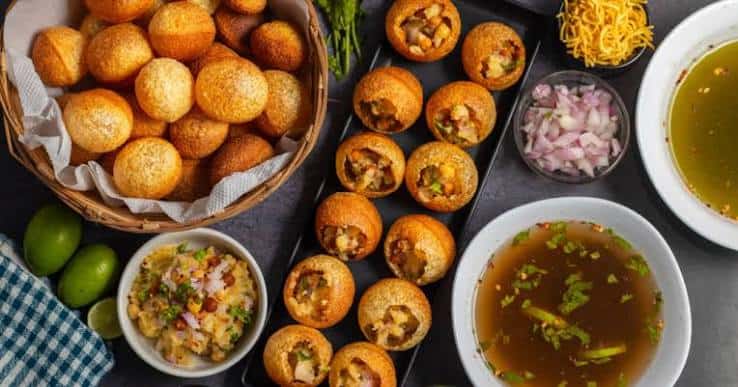
Pani Puri, Golgappa, and Puchka — A Contested Ancient Origin
Pani puri’s origins are genuinely disputed even among food historians, but one prominent theory traces the dish back to the Magadh region, present-day Bihar, during the legendary reign of King Mahabali, positioning it among the oldest street foods on this list by a considerable margin. The dish’s predecessor is widely considered to be chaat, which itself originated in northern India, and pani puri only spread nationwide during the 20th century as internal migration carried regional recipes into new cities, explaining why the same basic dish now goes by entirely different names, puchka in Bengal, golgappa across North India, and pani puri predominantly in Mumbai and Maharashtra.
That naming diversity is itself evidence of the dish’s migratory spread, since a single snack travelling through India’s linguistically fragmented regions naturally accumulated new names and subtle regional variations in spice level and chutney composition along the way.
Chaat — Possibly Born in the Mughal Royal Kitchens
Chaat, the broad umbrella term covering fried and boiled potatoes, puffed rice, mashed chickpeas, and myriad chutney combinations, is believed by some historians to have originated in the royal kitchens of Emperor Shah Jahan during the Mughal era, a genuinely aristocratic origin story for a dish now almost exclusively associated with roadside stalls. The word “chaat” itself derives from a Hindi word meaning “to lick,” a literal description of how thoroughly the tangy, spicy flavour combinations leave eaters licking their fingers clean.
That royal-kitchen-to-street-stall trajectory is a pattern that recurs across several Indian street foods, dishes originally crafted for aristocratic palates gradually democratised into affordable daily eating for entire cities, a genuinely different origin story than street foods born directly from working-class necessity.
Samosa — An 11th-Century Import From Persia
Unlike chaat’s disputed Indian royal-kitchen origins, the samosa’s earliest documented mention appears in 11th-century Persian literature, describing a savoury pastry snack served specifically in royal courts, meaning the dish arrived in India through trade and cultural exchange rather than originating domestically. The samosa’s journey from Persian court cuisine to India’s single most ubiquitous street snack, found in virtually every city and region regardless of local cuisine, reflects centuries of gradual adaptation as Indian cooks incorporated local spices, potato fillings, and regional chutney pairings into the original imported pastry concept.
Pav Bhaji and Vada Pav — Born From Colonial Bread and Mumbai’s Mill Workers
Pav bhaji originated specifically as a fast lunchtime meal for textile mill workers in Mumbai during the mid-1800s, designed to be quick, filling, and affordable enough for labourers working long factory shifts with limited time to eat. The genuinely crucial ingredient making the dish possible was pav, the soft bread roll, whose presence in Indian cuisine traces directly back to Portuguese colonial introduction of bread-baking techniques into Bombay and other Indian port cities, meaning pav bhaji is fundamentally a fusion dish combining a European staple with Indian spiced vegetable curry.
Vada pav followed a similar bread-dependent origin story roughly a century later, most commonly credited to a street vendor named Ashok Vaidya, who began selling the snack outside Dadar railway station in Mumbai around 1966, specifically targeting busy commuters needing a cheap, quick bite between train journeys. That railway-station origin explains why vada pav remains so closely associated with Mumbai’s fast-paced commuter culture even today, the dish was quite literally engineered around the rhythm of people rushing to catch trains.
Bhel Puri and Sev Puri — Mumbai’s Gujarati-Influenced Beach Snacks
Bhel puri’s origin remains genuinely disputed, with one theory crediting Gujarati migrants in Mumbai for adapting simpler North Indian chaat traditions into the puffed-rice-and-chutney combination now considered Mumbai’s single most popular street food, particularly associated with the city’s beaches. A competing claim comes from Mumbai’s Vithal restaurant, established in 1875, which asserts it invented the dish, while historical accounts also note the snack began being sold as street food specifically by migrants from Uttar Pradesh, with Gujarati and other Mumbai communities subsequently creating their own regional variations.
Sev puri, a closely related chaat variant topped with crunchy sev noodles, similarly traces its origin to either Pune or Mumbai, illustrating how many of Maharashtra’s most iconic street snacks emerged from the same general Mumbai-Pune culinary corridor during a period of intense migration and cultural mixing across communities.
Momos — A Tibetan Import Carried by 20th-Century Migration
Momos, now firmly embedded in Indian street food culture nationwide, particularly across Northeast India, originated in Tibet rather than India itself, and their arrival in the country traces specifically to the early 20th-century migration of Tibetan refugees into Indian territory. That refugee-driven origin story genuinely differentiates momos from most other dishes on this list, since it represents comparatively recent culinary migration rather than centuries-old trade route influence, and the dish’s spread from Northeast India into mainstream urban street food culture nationwide reflects how thoroughly momos have been embraced well beyond their original immigrant community.
The Colonial Bread Legacy That Reshaped Indian Street Food
Beyond individual dishes, the British colonial period introduced bread, cutlets, tea, and cakes into everyday Indian diets more broadly, and street vendors adapted quickly, creating entirely new hybrid snacks like bread pakoras, Irani chai, and bun maska, the latter specifically emerging from Irani cafes that opened across Mumbai in the late colonial period. That colonial bread legacy underpins not just pav bhaji and vada pav individually, but an entire category of Mumbai-specific street food innovation built around combining an imported staple with distinctly Indian flavour profiles and cooking techniques.
The Bottom Line
Nearly every iconic Indian street food carries a genuinely layered history of migration, colonial exchange, and city-specific invention rather than a single, clean indigenous origin story, chaat’s possible Mughal royal-kitchen roots, the samosa’s 11th-century Persian arrival, pav bhaji and vada pav’s dependence on Portuguese-introduced bread, and momos’ journey from Tibetan refugee communities into mainstream Indian eating all illustrate how thoroughly Indian street food reflects centuries of cultural collision. Understanding these origins doesn’t diminish the dishes’ authenticity, if anything, it reveals how genuinely adaptive and absorptive Indian street food culture has always been, taking outside influences and reshaping them into something distinctly, recognisably Indian within a generation or two.
Frequently Asked Questions
Q1. Is pani puri really India’s oldest street food, given its ancient Bihar origin claim?
A: While one theory traces pani puri back to the ancient Magadh region during King Mahabali’s legendary reign, the origin remains genuinely disputed among historians, and chaat, considered its broader predecessor, is separately linked to the Mughal era, so no single definitive “oldest” street food can be confirmed with certainty.
Q2. Why do so many popular Indian street foods involve bread if India traditionally uses rice and wheat flatbreads?
A: Dishes like pav bhaji and vada pav specifically rely on pav, a soft bread roll whose presence in Indian cuisine traces directly back to Portuguese colonial bread-baking techniques introduced in Bombay, making these dishes genuine fusion creations rather than purely traditional Indian recipes.
Q3. Who actually invented vada pav, and when?
A: Vada pav is most commonly credited to street vendor Ashok Vaidya, who began selling it outside Mumbai’s Dadar railway station around 1966, specifically designing it as a cheap, quick snack for busy train commuters.
Q4. Are momos considered an authentically Indian dish despite originating in Tibet?
A: Momos originated in Tibet and arrived in India through early 20th-century Tibetan refugee migration, but the dish has since become so deeply embedded in Indian street food culture, especially Northeast India and now nationwide, that it’s genuinely considered part of the modern Indian street food canon despite its foreign origin.
Q5. Why do the same street foods have different names in different parts of India?
A: Dishes like pani puri spread nationwide through internal migration during the 20th century, and as they moved into linguistically and culturally distinct regions, local communities gave them their own names, golgappa in the north, puchka in Bengal, and pani puri in Maharashtra, while also adapting the recipe slightly to local taste preferences.