
India carries one of the highest snakebite death tolls of any nation on earth — tens of thousands of lives lost annually, overwhelmingly among farmers, laborers, and rural communities with limited fast access to hospitals. Yet here’s the genuinely reassuring context most people miss: of the roughly 300 snake species found across India, only about 60 are venomous, and just four are responsible for the vast majority of serious, medically significant bites. Knowing which snakes you’re actually likely to encounter, and which ones genuinely matter, changes fear into informed awareness.
| Rank | Snake | Venom Status | Where Commonly Found |
| 1 | Indian Rat Snake | Non-venomous | Farms, suburbs, near rat populations |
| 2 | Indian Cobra | Highly venomous | Widespread, rural & semi-urban areas |
| 3 | Common Krait | Highly venomous | Rural homes, agricultural land, nocturnal |
| 4 | Russell’s Viper | Highly venomous | Farms, grasslands, near human settlements |
| 5 | Saw-Scaled Viper | Highly venomous | Dry regions, farms, outskirts |
| 6 | Checkered Keelback | Non-venomous | Ponds, drains, water bodies |
| 7 | Green Vine Snake | Mildly venomous | Forests, gardens, camouflaged in foliage |
| 8 | Indian Rock Python | Non-venomous (constrictor) | Forests, grasslands, near water |
| 9 | Common Wolf Snake | Non-venomous | Urban homes, gardens (mistaken for krait) |
| 10 | King Cobra | Highly venomous | Western Ghats, Northeast, dense forests |
1. Indian Rat Snake — The Farmer’s Genuine Friend
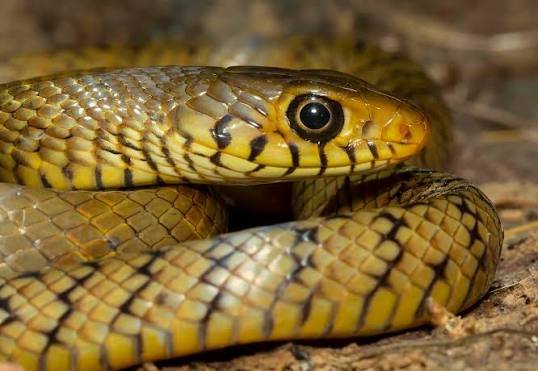
The Indian rat snake, known locally in Hindi as dhaman, is genuinely the most widespread non-venomous species encountered across Indian suburbs and farmland.
- Named directly after its primary prey — rats, using constriction to overcome rodents, birds, frogs, and small mammals.
- Considered a genuine farmer’s ally, protecting crops from rodent infestation by naturally controlling pest populations.
- Fast-moving, diurnal, and commonly found across Indian suburbs specifically wherever rat populations thrive.
2. Indian Cobra — The Most Recognized Venomous Species
- One of the “Big Four” medically significant venomous snakes responsible for the majority of serious snakebite incidents nationwide.
- Instantly recognizable by its distinctive hood, which displays a spectacle-like marking when spread in defense.
- Also known as the spectacled cobra, among the earliest recorded venomous snakes documented in India, with venom that’s highly neurotoxic.
3. Common Krait — The Nocturnal Danger
- A member of the deadly Big Four, responsible for nearly two-thirds of all snakebite deaths attributed to this group, largely because bites often occur while people sleep.
- Primarily nocturnal, making encounters genuinely harder to anticipate compared to daytime-active venomous species.
- Frequently and dangerously confused with the harmless common wolf snake due to similar banding patterns — a mix-up that can lead to either unnecessary panic or dangerous complacency.
4. Russell’s Viper — Widespread and Aggressive
- One of the Big Four, found extensively across farms, grasslands, and areas close to human settlements, making encounters genuinely common in agricultural regions.
- Bites typically occur during daytime or early darkness, differentiating its activity pattern from the nocturnal krait.
5. Saw-Scaled Viper — The Smallest but Most Aggressive
- Completes the Big Four, and despite its comparatively small size, is considered the most aggressive member of this medically significant group.
- Predominantly found in dry regions, farm outskirts, and hillocks, often camouflaged effectively among leaf litter.
6. Checkered Keelback — India’s Common Water Snake
- Also known as the Asiatic water snake, or locally as pani ka saanp, this genuinely widespread non-venomous species thrives near ponds, drains, and lakes across India.
- A diurnal, semi-aquatic species that primarily feeds on small fish and water frogs, playing a genuine ecological role in maintaining aquatic population balance.
7. Green Vine Snake — The Camouflage Specialist
- The most prevalent Ahaetulla species in India, found across evergreen and deciduous forests as well as the grasslands of the Western Ghats.
- Slightly venomous but not medically significant to humans in typical encounters — often commonly mistaken for a cobra and unfortunately killed out of unwarranted fear.
- Uses binocular vision to hunt frogs and lizards, relying primarily on camouflage as a slow-moving vine specialist rather than active pursuit.
8. Indian Rock Python — The Gentle Giant
- A large, genuinely non-venomous constrictor that subdues prey by coiling rather than through venom, found across forests, grasslands, and areas near water.
- Represents one of India’s most impressive snake species by sheer size, though poses minimal direct danger to humans under normal circumstances.
9. Common Wolf Snake — Frequently Mistaken for Danger
- A genuinely harmless species that gets frequently and dangerously mistaken for the common krait due to similar banding patterns.
- Commonly found in urban homes and gardens, making correct identification genuinely important to avoid both unnecessary panic and misplaced complacency around actually dangerous species.
10. King Cobra — The Longest Venomous Snake on Earth
- Found mainly in the forests of the Western Ghats, the northeast, and parts of the eastern coast, the king cobra holds the distinction of being the longest venomous snake on the planet.
- Primarily feeds on other snakes, reflecting its scientific name Ophiophagus, which translates roughly to “snake-eater.”
- Despite its fearsome reputation, encounters with humans remain comparatively rare given its preference for dense, undisturbed forest habitat.
The Genuine Scale of India’s Snake Diversity
- Nearly 300 snake species inhabit India’s varying habitats, of which more than 60 are venomous, over 40 mildly venomous, and roughly 180 are entirely non-venomous.
- These species fall under four major families — Colubridae, Elapidae, Hydrophiidae, and Viperidae — each with distinct evolutionary and behavioral characteristics.
- The Colubridae family, evolved 35-55 million years ago, represents the largest and most diverse snake family in India, comprising mostly non-venomous species like keelbacks, rat snakes, and wolf snakes.
Why India’s Snakebite Burden Remains So High
- WHO estimates place annual snakebites at approximately 83,000 with roughly 11,000 deaths, disproportionately affecting rural and agricultural communities.
- Most bites occur during monsoon months (June to September), when both snake activity and human agricultural work increase simultaneously.
- The Big Four species — Indian cobra, common krait, Russell’s viper, and saw-scaled viper — are responsible for the overwhelming majority of medically significant bites specifically because their habitats consistently overlap with human settlements and farmland.
The Bottom Line
The vast majority of snakes an Indian resident is likely to encounter — rat snakes, checkered keelbacks, green vine snakes, and rock pythons — are genuinely non-venomous or pose minimal medical risk, while the handful of truly dangerous species, the Big Four, warrant genuine respect and caution given their habitat overlap with human communities. Learning basic identification, particularly distinguishing the harmless wolf snake from the dangerous krait, does more to protect both people and India’s ecologically valuable snake population than fear-driven killing of every encountered species. This is general educational information, not medical guidance — anyone bitten by any snake should seek immediate medical attention at the nearest hospital, since accurate identification and prompt antivenom treatment genuinely matter for survival.
FAQs
Q1. What should I do immediately if bitten by a snake in India, regardless of species?
Stay calm, immobilize the affected limb, avoid cutting or sucking the wound, and get to the nearest hospital immediately for professional evaluation and treatment.
Q2. How can I tell the difference between a dangerous krait and a harmless wolf snake?
This distinction is genuinely difficult for non-experts; the safest approach is treating any banded nocturnal snake with caution and avoiding handling regardless of suspected species.
Q3. Are most snake encounters in Indian homes and gardens actually dangerous?
No, species like rat snakes, wolf snakes, and checkered keelbacks commonly found around homes are non-venomous and pose minimal genuine threat to humans.
Q4. Why do most serious snakebites occur specifically during monsoon season in India?
Increased snake activity combined with more agricultural work and flooding that displaces snakes from their usual habitats both contribute to this seasonal spike.