
Yes, fog lamps are legal in India — both factory-fitted ones and properly compliant aftermarket installations. But “legal” comes with real conditions attached, covering everything from what color light is permitted to when you’re actually allowed to switch them on. Get any of these details wrong, and a perfectly legitimate safety accessory can turn into a source of fines.
The Governing Framework
- Fog lamp regulation in India sits across a layered legal structure: the Motor Vehicles Act, 1988 provides the overarching legal authority, the Central Motor Vehicles Rules (CMVR), 1989 regulate vehicle lighting equipment specifically, and CMVR Rule 124 empowers detailed Automotive Industry Standards (AIS) documents, published by ARAI (Automotive Research Association of India) and notified by the Ministry of Road Transport and Highways, which lay out the precise technical specifications.
- AIS-008 and AIS-009 specifically govern lighting installation on motor vehicles, and more recent regulatory updates have brought fog lamps under AIS-009/AIS-012 photometric criteria, tightening the technical standards fog lamps must meet.
Factory-Fitted Fog Lamps: Unambiguously Legal
- Using factory-fitted fog lamps in genuinely appropriate conditions — fog, heavy rain, dust — is completely legal. Since these come pre-certified and installed by the vehicle manufacturer as part of the originally approved specification, there’s no compliance question to navigate here.
- Under the CMVR, all four-wheelers manufactured after 2005 are actually required to have at least one rear fog lamp, fitted to the rear right or center of the vehicle, reflecting how central fog lamps have become to standard vehicle safety design, not an optional add-on.
Aftermarket Fog Lamps: Legal, But With Real Compliance Requirements
This is where most of the genuine legal nuance lives, since this is where people run into trouble.
- Aftermarket fog lamps are legal in India, provided they comply with the color, intensity, placement, and beam-pattern standards set out under CMVR and the relevant AIS documents. They aren’t banned — but installing a non-compliant unit creates genuine legal exposure.
- Section 52 of the Motor Vehicles Act, the same provision that governs unauthorized structural modifications (covered in questions about engine swaps and open jeeps), is specifically relevant here too — altering a vehicle’s lighting setup beyond its original specification without proper compliance can be treated as an unauthorized alteration.
The Specific Compliance Rules
Color is the single most important rule:
- Fog lamps must emit white or yellow (amber/selective yellow) light only.
- Red, green, or blue fog lamps are explicitly illegal on the front of a vehicle — these colors are reserved for very specific purposes (brake lights, emergency vehicles) and are never permitted as general fog lamp colors.
Placement matters:
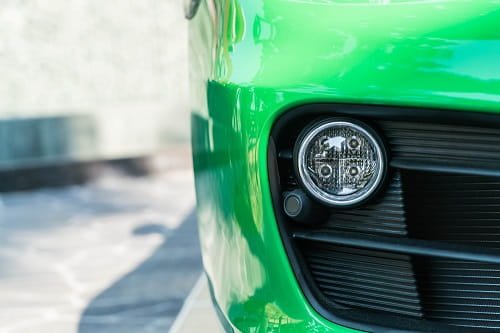
- Fog lamps should be mounted below the main headlamp level. Lamps mounted at or above headlight height get treated as additional headlights, which brings a stricter set of rules into play, rather than being treated as supplementary fog lighting.
No flashing:
- Flashing fog lights are illegal, since this can distract or confuse other drivers — fog lamps are meant to provide steady, consistent illumination, not act as an attention-grabbing strobe.
Intensity limits apply:
- Fog lamps must stay within prescribed luminous intensity (brightness) limits under the applicable AIS standards — an excessively bright aftermarket unit that dazzles oncoming traffic isn’t compliant, regardless of its color.
When You’re Actually Allowed to Use Them
This is a separate, equally important rule from the equipment compliance question above.
- Fog lamps are meant to be used only in genuinely poor visibility conditions — fog, heavy rain, dust storms, or similar situations where standard headlights aren’t sufficient.
- Using fog lamps in clear weather conditions is explicitly against the rules and can itself attract a fine, independent of whether the fog lamp equipment itself is fully compliant. The equipment being legal doesn’t mean using it whenever you feel like is also legal.
Penalties for Non-Compliance
- Violations of fog lamp rules — whether it’s using illegal colors, improper placement, or using them in clear weather — can result in fines, commonly cited as up to ₹5,000 under relevant Motor Vehicles Act provisions governing traffic rule violations, including Section 177.
- If fog lamps are found to have contributed to an accident or caused dangerous dazzle to other drivers, enforcement can escalate further, with some sources noting potential vehicle impoundment in cases where non-compliant lighting is directly implicated in causing harm.
Fog Lamps on Motorcycles: The Same Core Principles
- Fog lamps (and auxiliary driving/passing lights) are legal on motorcycles in India, governed by the same core Motor Vehicles Act and CMVR framework that applies to four-wheelers.
- The same fundamental rules apply: white or yellow light only, mounted below headlight level, with no red or blue flashing lights permitted on private vehicles (these remain strictly reserved for emergency and police vehicles).
- Motorcycle riders specifically should ensure the fog lamp’s beam is angled downward and the unit doesn’t sit above headlight height, since this is treated as effectively adding an unauthorized additional headlamp rather than a compliant auxiliary fog light.
Practical Guidance for Staying Compliant
- Stick to white or yellow (amber) fog lamps only — this single rule eliminates most compliance risk immediately.
- Mount any aftermarket unit below your headlamp level, never above or level with it.
- Avoid any flashing or strobing fog lamp products, regardless of how they’re marketed.
- Use fog lamps only when visibility is genuinely compromised — not as a default driving habit or for aesthetic reasons in clear conditions.
- Inform your insurance provider about any aftermarket lighting modification, since undisclosed modifications can sometimes complicate claims processing if ever relevant to an incident.
Frequently Asked Questions
Q1. Can I install red or green LED fog lights on my car for a stylistic look?
No — red and green are not permitted fog lamp colors under Indian regulations; only white or yellow (amber) light is legal for front fog lamps, and using non-standard colors can result in fines under the Motor Vehicles Act.
Q2. Is it illegal to drive with my fog lamps on during normal, clear nighttime driving?
Yes, technically — fog lamps are specifically meant for genuinely poor visibility conditions like fog, heavy rain, or dust, and using them in clear weather conditions is against the rules and can attract a fine, separate from whether the fog lamp hardware itself is compliant.
Q3. Do I need to get aftermarket fog lamps certified by ARAI before installing them?
ARAI doesn’t typically certify individual retail products directly to consumers, but the lamps you install should meet the dimensional, luminous flux, color, and beam-angle specifications set out under the relevant AIS standards (AIS-008/AIS-009) — buying from a reputable source that can demonstrate compliance with these standards is the practical way to ensure your installation stays within legal bounds.
Q4. What’s the difference in legal treatment between a fog lamp mounted below the headlight versus one mounted above it?
A fog lamp mounted below headlight level is treated as a standard auxiliary fog light under the applicable rules, while one mounted at or above headlight height gets treated as an additional headlamp, which falls under stricter compliance requirements — this placement distinction is one of the more commonly overlooked compliance points for both motorcycle and car installations.