
Mumbai ranked No. 10 on Time Out’s World’s Best Street Food Cities list for 2026, with Jaipur at No. 15 and Delhi at No. 19, making India the only country to place three cities in the global top 20 — a remarkable showing for a food culture built almost entirely around handcarts, tawas, and roadside stalls rather than restaurants. Understanding why street food has become so deeply woven into daily life across Indian cities reveals something genuine about economics, history, and how urban India actually functions.
Roots Stretching Back Millennia
Street food in India isn’t a modern convenience trend layered onto an older restaurant culture — it predates organised dining by thousands of years. Archaeological excavations at Harappa, dating back to roughly 2500 BCE, have uncovered clay ovens and grain stalls suggesting ancient food markets existed as part of daily urban life even in the Indus Valley Civilisation. By the Mughal era in the 16th century, bustling bazaars sold kebabs and biryanis, practices documented in the historical text Ain-i-Akbari, and colonial port cities like Bombay and Calcutta later birthed genuine fusion dishes, pav bhaji’s origins are commonly traced to Portuguese-introduced bread combined with local spiced vegetable preparations.
That continuity matters, since it means street food in India isn’t filling a gap left by an absent restaurant industry, it’s a genuinely independent, self-sustaining culinary tradition that has evolved continuously for centuries rather than emerging as a byproduct of modern urban poverty or convenience alone.
Post-Independence Urbanisation Supercharged the Demand
The scale of India’s modern street food economy owes much to what happened after 1947. Industrialisation and rapid urban population growth following independence drove a genuine boom in street food demand, as mass migration into cities created enormous need for fast, affordable meals for workers who had left rural households and home-cooked food behind. Vendors set up outside railway stations, college gates, and government offices, feeding a growing urban workforce that had neither the time nor kitchen access to cook for themselves.
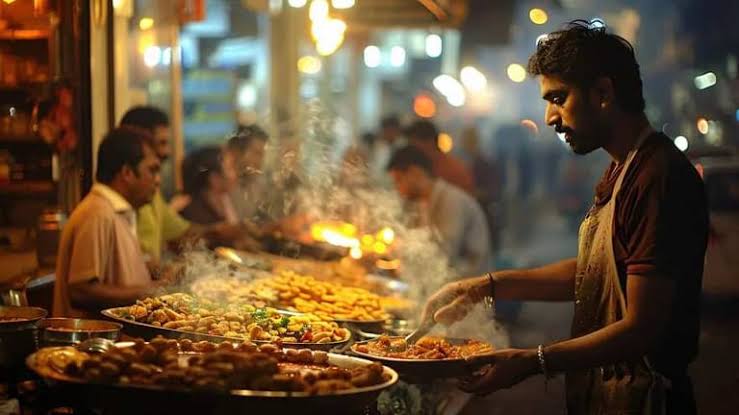
The 1980s and 1990s are widely regarded as when Indian street food genuinely found its distinctive character — pav bhaji sizzling on giant tawas in Mumbai, chaat carts dominating Delhi street corners, and Kolkata’s kathi rolls becoming a genuine lunchtime institution. Carts became neighbourhood landmarks, and specific vendors became local legends known by name, a pattern of personal, informal food commerce that restaurant dining, with its fixed menus and formal service, simply doesn’t replicate.
The Economics Make It Genuinely Difficult to Replace
Street food remains dramatically less expensive than restaurant dining, and vendors deliberately cluster around the exact locations where demand concentrates, colleges, railway stations, office districts, and crowded market areas, minimising the time and effort required for customers to grab a quick, satisfying meal between commitments. In cities like Pune, streets such as FC Road are loved specifically by students precisely because vendors offer affordable, quick-service food that fits between classes, while similar dynamics play out at university and office clusters nationwide.
This affordability and accessibility genuinely serves two overlapping needs simultaneously: working professionals and students who need fast, cheap meals during packed daily schedules, and vendors themselves, who can enter the food business with dramatically lower capital requirements than opening a restaurant. That low barrier to entry has made street vending a genuinely significant informal-economy livelihood across Indian cities, offering self-employment opportunities to migrants and women who might otherwise struggle to access formal employment.
Street Food Functions as Genuine Social Infrastructure
Beyond nutrition and economics, street food stalls function as informal community gathering spaces, locations where people interact outside the more rigid social contexts of home or workplace. Regular customers develop familiar relationships with specific vendors, turning a daily food purchase into a small recurring social interaction, and during festivals specifically, stalls become genuine focal points for celebration, Diwali’s mithai carts and Eid’s sheer khurma vendors drawing crowds well beyond their everyday customer base.
This social function helps explain why street food has remained so central to Indian urban identity even as incomes have risen and restaurant dining has become more accessible to the middle class. The stall isn’t simply a cheaper substitute for a restaurant meal, it fills a genuinely different role as an informal, everyday meeting point woven into the rhythm of commuting, working, and studying in a busy city.
Regional Identity Expressed Through Food
India’s street food landscape also reflects the country’s extraordinary regional diversity in a way few other cultural expressions manage as directly. Nearly every major city has developed a signature street food identity, Mumbai’s vada pav, Delhi’s chaat, Pune’s misal pav, Bangalore’s iconic food streets like VV Puram Food Street and Thindi Beedi, and Chandigarh’s late-night kulcha hubs that trace their origins back to feeding construction workers during the city’s 1950s founding under architect Le Corbusier. Each city’s specific dishes and vending traditions carry genuine local history, whether that’s colonial-era fusion, Partition-era migration patterns, or simply decades of accumulated culinary experimentation by generations of local vendors.
That regional specificity has increasingly become a genuine tourism draw as well, with cities like Bangalore explicitly promoting their street food markets as cultural attractions that shape the city’s broader image, drawing both domestic travellers and international visitors specifically seeking authentic, non-restaurant culinary experiences.
The Bottom Line
Street food thrives in Indian cities because it sits at the genuine intersection of ancient culinary tradition, post-independence urban economics, and ongoing social function, offering affordable, fast, and culturally rooted food precisely where and when urban Indians need it most. With three Indian cities ranking among the world’s best street food destinations in 2026 and vendors continuing to serve as both an economic lifeline for millions and an informal social infrastructure connecting neighbourhoods, street food remains far more than a budget dining option, it’s a living, continuously evolving expression of how Indian cities actually eat, work, and gather together.
Frequently Asked Questions
Q1. Is street food actually safe to eat in Indian cities, given hygiene concerns?
A: Studies suggest food preparation practices among many street vendors are comparable to standard restaurant hygiene, though quality genuinely varies by vendor, so choosing stalls with high customer turnover and food cooked fresh in front of you remains the most reliable way to reduce risk.
Q2. Why do certain Indian cities have such strong, distinct street food identities?
A: Regional street food identities, like Mumbai’s vada pav or Kolkata’s kathi rolls, developed through a combination of local ingredient availability, historical trade and colonial influences, and decades of vendor experimentation, giving each city a genuinely distinct culinary signature rather than a generic shared street food culture.
Q3. How significant is street vending as a source of employment in Indian cities?
A: Street food vending provides a genuinely important informal-economy livelihood for millions of Indians, including many migrants and women, largely because it requires considerably lower startup capital than opening a restaurant, making it one of the more accessible paths into self-employment in urban India.
Q4. Which Indian cities are internationally recognised for their street food scenes?
A: Mumbai, Jaipur, and Delhi all featured on Time Out’s World’s Best Street Food Cities list for 2026, at positions 10, 15, and 19 respectively, making India the only country with three cities in the global top 20, alongside other genuinely notable food destinations like Bangalore, Pune, Indore, and Chandigarh.
Q5. Has India’s street food culture changed significantly in recent decades?
A: Yes, the scene has evolved considerably since the 1980s and 90s “golden era,” with fusion trends, health-conscious variations, and social media-driven food discovery reshaping how vendors present and market their offerings, even as the fundamental appeal of affordable, fast, community-centred eating has remained consistent.