
75% of resumes never actually reach a human recruiter — they’re eliminated first by Applicant Tracking System (ATS) software that over 90% of mid-size and large Indian companies now use before a person even loads the file. And for the resumes that do survive that first automated filter, recruiters spend just 6-8 seconds deciding whether to keep reading or hit delete. In a market with over 100 million registered job seekers competing on platforms like Naukri.com alone, understanding exactly which mistakes trigger rejection genuinely determines whether your qualifications ever get a fair chance to be seen.
| Rank | Mistake | Consequence |
| 1 | ATS-incompatible formatting (tables, columns, graphics) | Resume never parsed correctly, silently rejected |
| 2 | Not mirroring job description keywords | Fails ATS keyword matching despite genuine qualification |
| 3 | Typos and grammatical errors | Signals carelessness, easy excuse to reject |
| 4 | Unprofessional email address | Undermines professional image immediately |
| 5 | Sending the same resume to every job | Fails to match specific role requirements |
| 6 | Overloaded, dense text without structure | Recruiters won’t read long unstructured paragraphs |
| 7 | Missing or vague professional summary | Wastes prime top-of-page real estate |
| 8 | Unexplained employment gaps | Invites worst-case assumptions from recruiters |
| 9 | Using abbreviations without full forms | ATS may not match “ML” to “Machine Learning” |
| 10 | Padding with irrelevant details (“References available”) | Wastes space that could hold keyword-rich content |
1. ATS-Incompatible Formatting — The Silent Rejection
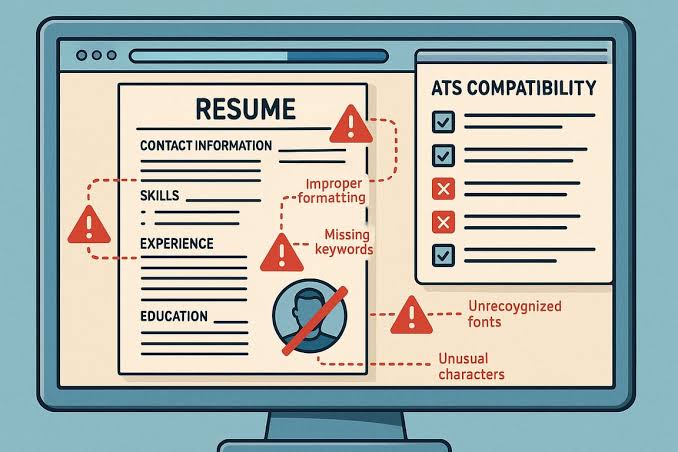
This is genuinely the most dangerous and widespread mistake, since it eliminates qualified candidates before a human ever sees their resume.
- Complex layouts with columns, tables, charts, text boxes, and graphics often break when parsed by automated systems, since ATS software reads resumes left-to-right, top-to-bottom as a single text stream.
- Indian job seekers frequently download visually impressive templates without realizing they’ll fail ATS parsing entirely — the bot can’t read it, meaning the recruiter never will either.
- Job chances can drop by up to 80%, even for highly qualified candidates, purely due to formatting choices that prevent proper data extraction.
2. Not Mirroring the Job Description’s Exact Language
- ATS systems match words in your resume against words in the job description, often literally rather than contextually.
- If the job description says “stakeholder management” and you write “managing relationships with key stakeholders,” the system may not register this as a match, even though the meaning is essentially identical.
- Copying exact truthful phrases directly from the job description into your resume genuinely improves ATS matching accuracy.
3. Typos and Grammatical Errors
- These errors undermine credibility regardless of actual skill level, making a candidate appear careless or lacking attention to detail.
- In a competitive market, a single spotted typo becomes an easy excuse for a recruiter to hit delete, particularly when hundreds of other applications await review.
- Reading your resume aloud slowly, using spell-check tools without total reliance on them, and having a printed copy reviewed by another person all catch errors your tired eyes might overlook on screen.
4. Unprofessional Email Addresses
- An email address like “cool_guy_99@hotmail.com” genuinely fails to project a professional image, regardless of how strong the rest of your resume content is.
- A clean, simple format — lastname@gmail.com — signals basic professionalism before a recruiter reads a single line of actual content.
5. Sending the Same Generic Resume to Every Job
- Mass-applying with one identical resume across dozens of openings is a losing strategy, since it fails to reflect the specific requirements each individual role actually demands.
- If you’re targeting a project-management role specifically, your project achievements must appear prominently in the first half of page one, not buried under an unrelated older job title further down.
- Reordering bullet points within each role so the most relevant achievements appear first genuinely improves your match against each specific job’s requirements.
6. Dense, Unstructured Text Blocks
- Recruiters facing long, dense paragraphs without bullet points or white space simply won’t attempt to read them given the extreme time pressure they operate under.
- A common misconception is that more text signals more experience — in reality, it signals poor prioritization and makes your genuinely strongest qualifications harder to find quickly.
7. Missing or Vague Professional Summary
- The top third of your resume is prime real estate, yet most candidates leave it empty or write something genuinely ambiguous rather than purposeful.
- This section should clearly answer “who are you and why you?” within roughly ten seconds of a recruiter’s initial scan.
8. Unexplained Employment Gaps
- Genuine career gaps aren’t actually the core problem — unexplained gaps specifically invite the worst-case assumption from a reviewing recruiter.
- A single clarifying line — further education, family responsibility, a sabbatical, or a layoff during an economic downturn — removes the question mark entirely.
- Recruiters in 2026 are genuinely far more accepting of career breaks than most candidates fear, but silence around a gap tends to work against you regardless.
9. Using Abbreviations Without Their Full Forms
- Writing “ML” instead of “Machine Learning,” “NLP” instead of “Natural Language Processing,” or similar shorthand is a genuinely common mistake among Indian job seekers.
- Depending on the specific ATS system and whether the employer configured synonym libraries, these abbreviations may simply fail to match the full terms used in the actual job description.
10. Padding With Irrelevant Filler Content
- Lines like “References available upon request” appear on a shocking number of Indian fresher resumes, wasting 2-3 lines that could instead hold keyword-rich, relevant content.
- No recruiter in 2026 genuinely requests references during initial screening, making this line pure wasted space that could better serve another project bullet point or additional technical skill.
- Similarly, listing every training certificate from the last twenty years or cramming fifty skills into a single dense block signals padding rather than genuine, defensible expertise.
The Bottom Line
With over 90% of mid-size and large Indian companies now filtering resumes through ATS software before any human review, and recruiters spending mere seconds on whatever survives that initial screen, the mistakes that matter most are the ones invisible to candidates themselves — broken formatting, mismatched keywords, and generic mass-application content. Fixing these ten issues — from choosing ATS-friendly formatting over visually elaborate templates to genuinely tailoring each application around the specific job description’s language — remains the single most effective way to ensure your actual qualifications get the fair chance they deserve to be seen and evaluated.
FAQs
Q1. How can I check if my resume is actually ATS-friendly before submitting it?
Use a plain-text, single-column format without tables or graphics, and several free online ATS checker tools can scan your resume against a specific job description for compatibility.
Q2. Should I list every job I’ve ever held, or focus only on recent relevant experience?
For professionals with up to 15 years of experience, keep it to two pages maximum, condensing early-career roles into one line each rather than listing exhaustive detail.
Q3. Is it better to have a longer resume that shows all my skills, or a shorter, focused one?
A shorter, focused resume listing only skills you can genuinely defend in an interview performs better than a long document cramming in fifty loosely related skills.
Q4. How should I explain a career gap on my resume without drawing unnecessary attention to it?
A single brief line noting the genuine reason — education, family responsibility, or a layoff — is sufficient; recruiters generally respond better to honest brevity than to silence.