
Nearly every Indian student growing up under the country’s Three-Language Formula learns something genuinely unusual by global standards — not one, not two, but three languages as a structured part of their core curriculum, starting as early as Grade 6 under the latest CBSE reforms. With India recognizing 22 official languages across five distinct language families, understanding exactly which languages actually dominate Indian classrooms reveals a lot about how the country balances national unity, regional identity, and global competitiveness within its education system.
| Rank | Language | Where It Dominates | Role in Curriculum |
| 1 | English | Nationwide | R1 (First language) or link language |
| 2 | Hindi | Hindi-speaking states + widely taught elsewhere | Native/link language |
| 3 | Sanskrit | Hindi-speaking states especially | Most common third language choice |
| 4 | Regional State Language (varies) | Non-Hindi states | Mother tongue/medium of instruction |
| 5 | Tamil | Tamil Nadu, parts of South India | Regional/classical language |
| 6 | Telugu | Andhra Pradesh, Telangana | Regional language |
| 7 | Kannada | Karnataka | Regional language |
| 8 | Malayalam | Kerala | Regional/classical language |
| 9 | Urdu | North India (as third language option) | Optional third language |
| 10 | Foreign languages (French, German, Spanish, Japanese) | Urban schools, secondary level | Optional additional language |
1. The Three-Language Formula — India’s Foundational Language Policy
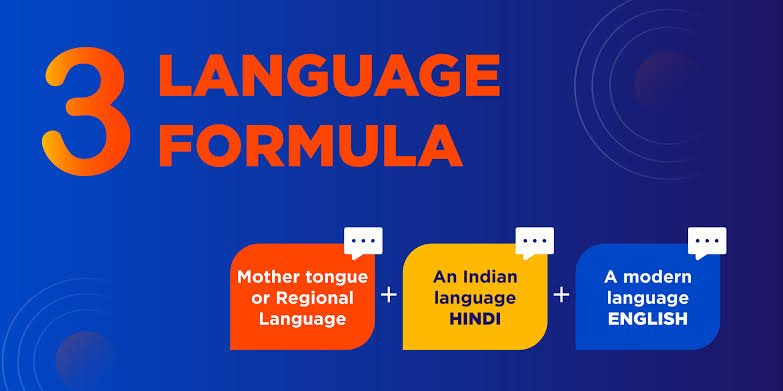
The structure behind India’s school language teaching traces directly back to a policy first formulated over five decades ago and still evolving today.
- Originally recommended by the National Commission on Education (1964-1966), also known as the Kothari Commission, and formally adopted as part of the National Policy on Education, 1968.
- The basic structure remains straightforward: in Hindi-speaking states, students learn Hindi, English, and a modern Indian language (preferably a southern language); in non-Hindi-speaking states, students learn the regional language, Hindi, and English.
- Under NEP 2020, the formula was liberated to become genuinely more flexible, stating that “the three languages learned by children will be the choices of the states, regions, and of course the students themselves, so long as at least two of the three languages are native to India.”
2. English — The Universal Link Language
- English functions as India’s most consistently taught language nationwide, whether as the primary medium of instruction or as a compulsory subject alongside regional languages.
- Under CBSE’s revised structure starting 2026-27, Grade 6 students studying under an English-medium framework must select 2 Indian languages alongside English to complete their three-language requirement.
- Serves as the practical bridge language enabling participation in global affairs and professional communication, a role explicitly built into the original 1968 policy’s design.
3. Hindi — The Most Widely Taught Indian Language
- Hindi appears in school curricula across the vast majority of Indian states, whether as a native first language in Hindi-speaking states or as the mandatory second/third language elsewhere.
- Data from Hindi-speaking states shows genuinely overwhelming coverage — Bihar (99.1% of schools), Uttar Pradesh (94%), and Uttarakhand (99.5%) all teach Hindi extensively.
- Even in non-Hindi-speaking states like Gujarat, roughly 64% of schools still teach Hindi, reflecting its role as a genuine national link language beyond its native-speaking regions.
4. Sanskrit — The Most Common Third Language Choice
- Despite the original 1968 policy specifically recommending a modern southern Indian language as the third language in Hindi-speaking states, Sanskrit has become the genuinely dominant default choice instead.
- Coverage figures are striking: 56% of Bihar schools, 65.2% of UP schools, and 79.4% of Uttarakhand schools teach Sanskrit as their third language option.
- Under CBSE’s 2026-27 reforms, students can now choose combinations like English (R1), Hindi (R2), and Sanskrit (R3), though the rules mandate that at least two of the three chosen languages remain native to India.
5. Regional State Languages — The Mother Tongue Foundation
- NEP 2020 places genuine emphasis on teaching in the mother tongue or local language as the medium of instruction, at least until Grade 5, preferably through Grade 8.
- This reflects evidence that young children grasp concepts more easily when taught in a language they already understand, with ages two to eight representing the period when children acquire language most quickly.
- In non-Hindi-speaking states specifically, the regional language forms the foundational first language, around which Hindi and English are then layered as the second and third languages.
6. Tamil, Telugu, Kannada, and Malayalam — The Southern Language Cluster
- These four Dravidian languages anchor education specifically within their respective states — Tamil Nadu, Andhra Pradesh/Telangana, Karnataka, and Kerala.
- NEP 2020 specifically recommends classical languages including Tamil, Telugu, Kannada, Malayalam, Sanskrit, and Odia as additional optional subjects, recognizing their deep literary and cultural heritage.
- Tamil Nadu specifically has historically opposed the broader Three-Language Formula, preferring to prioritize Tamil and English rather than adding a third compulsory language.
7. Urdu — A Persistent Third Language Option in North India
- Urdu remains a genuine option within the third-language slot in several North Indian states, alongside Sanskrit and Punjabi.
- Haryana’s implementation of the three-language formula for Classes 9 and 10 specifically lists Sanskrit, Urdu, or Punjabi as compulsory third-language choices alongside mandatory Hindi and English.
8. Foreign Languages — An Emerging Secondary-Level Option
- Beyond Indian languages and English, NEP 2020 explicitly permits students at the secondary level to study Korean, Japanese, French, German, and Spanish, among other foreign languages.
- Under CBSE’s revised rules, students choosing a foreign language like Spanish or French must still include 2 Indian languages within their overall three-language combination, ensuring the core Indian-language requirement remains intact regardless of foreign language interest.
How the 2026-27 CBSE Reforms Are Reshaping Language Learning
- CBSE will launch its revised third language choice for Grade 6 students starting the 2026-27 academic year, categorizing languages into R1, R2, and R3
- Mandatory passing in all three languages is now required for Class 10 Board certificate eligibility, reflecting genuinely increased weight placed on multilingual proficiency.
- The National Curriculum Framework for School Education 2023 advocates that students continue learning all three languages through Grades 9 and 10 specifically to build lasting proficiency rather than treating language study as a box to check in earlier grades.
The Bottom Line
India’s Three-Language Formula, first conceived in 1968 and substantially liberalized under NEP 2020, ensures that virtually every Indian student encounters English, Hindi (or their regional mother tongue), and a third language — most commonly Sanskrit in Hindi-speaking states — throughout their schooling, reflecting the country’s genuine attempt to balance national unity, regional linguistic identity, and global competitiveness within a single education system. With CBSE’s 2026-27 reforms mandating passing grades across all three languages and NEP 2020 continuing to promote classical Indian languages like Tamil, Telugu, and Malayalam alongside foreign language options, India’s school language landscape remains a genuinely dynamic, still-evolving reflection of the country’s extraordinary linguistic diversity.
FAQs
Q1. Is it mandatory for every Indian student to learn Hindi regardless of their home state?
Not strictly mandatory nationwide — NEP 2020 requires at least two of three languages to be native to India, but states retain flexibility in choosing which specific languages to teach.
Q2. Why does Sanskrit remain the most common third language choice despite policy recommending southern languages instead?
Sanskrit’s widespread availability, established teacher training infrastructure, and cultural significance have made it the practical default choice, even though it doesn’t fulfill the original policy’s intent of promoting modern regional language diversity.
Q3. Can students choose a foreign language like French instead of a third Indian language entirely?
No, even when selecting a foreign language like French or Spanish, students must still include two Indian languages within their overall three-language combination under current rules.
Q4. Does learning three languages in school actually help students academically compared to focusing on fewer languages?
Research generally supports multilingual education benefits, particularly when foundational learning happens in a familiar mother tongue before introducing additional languages progressively.