
Few Indian cities carry their historical identity as visibly as Jhansi. The story of Rani Lakshmibai — the warrior queen who died defending her kingdom against British annexation in 1858 — is not merely folklore here but a living civic presence. The Jhansi Fort looms over the city from its rocky basalt ridge, and the lanes below it carry names and associations that connect everyday urban life to one of India’s most celebrated episodes of resistance. Into this historically weighted cityscape, the UPSRTC bus station on Talpura Road functions as the practical mobility hub of a city that sits at one of India’s most important railway and highway junctions.
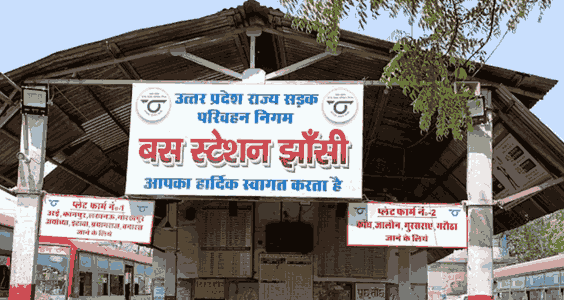
Jhansi Bus Station, also called Jhansi ISBT, is positioned in the Talpura locality on the city’s southern side, serving as the primary UPSRTC terminal for bus connectivity across the Bundelkhand region, southern Uttar Pradesh, and to Madhya Pradesh’s key cities. The station’s highway context is extraordinary — Jhansi sits at the convergence of NH-27, NH-75, NH-44, and NH-39, making it one of the most multiply-connected highway cities in the UP-MP border zone. Buses to Gwalior (Madhya Pradesh), Kanpur, Agra, Lucknow, Prayagraj, and Bhopal all depart from here, with private operators supplementing UPSRTC on the Gwalior and Bhopal corridors heavily.
The Bundelkhand Expressway, operational since July 2022, has added a premium road connectivity dimension — buses reaching Etawah 300 kilometres northeast in approximately 3.5 hours from the eastern end of the expressway, from where the Agra-Lucknow and Yamuna Expressways extend the network further.
Overview Table
| Detail | Information |
| Name | Jhansi Bus Station / Jhansi ISBT |
| Location | Talpura, Jhansi, Uttar Pradesh — 284002 |
| Operated By | UPSRTC (Primary); MPSRTC (MP routes); Private Operators |
| Key Routes | Gwalior, Kanpur, Agra, Lucknow, Prayagraj, Bhopal, Sagar, Chitrakoot |
| Bus Service Types | Hi-Tech AC, Deluxe, Semi-Deluxe, Ordinary, Jan Rath |
| Distance from Jhansi Railway Junction | Approx. 3–5 km |
| Distance from Gwalior | Approx. 100 km; 2–2.5 hours |
| Distance from Kanpur | Approx. 250 km; 4–5 hours |
| Distance from Agra | Approx. 225 km; 4–4.5 hours |
| Distance from Lucknow | Approx. 350 km; 6–7 hours |
| Distance from Bhopal (MP) | Approx. 320 km; 5.5–6.5 hours |
| Distance from Delhi | Approx. 410 km; 7–8 hours |
| Nearest Airport | Jhansi Airport — Approx. 8–10 km |
| Highway Convergence | NH-27, NH-75, NH-44, NH-39 all meet near Jhansi |
| Governing Authority | UPSRTC |
| Helpline | 1800 180 2877 (24/7) |
Location
Jhansi Bus Station occupies the Talpura area on the city’s southern side — a centrally accessible position for the largely historic and residential city grid. Talpura itself is an established neighbourhood carrying the older city’s residential character, and the surrounding streets have the commercial density of a terminal zone — hotels, restaurants, and transport-related services clustered around the bus stand’s approach roads. The fort’s silhouette visible from the higher ground of this zone is one of those incidental urban views that makes arriving in Jhansi by bus a more memorable experience than most similar journeys.
Directions
From Jhansi Railway Junction: Travel approximately 3 to 5 kilometres by auto-rickshaw or cab, 10 to 20 minutes through the Jhansi city road network. Jhansi Junction is one of India’s busiest railway junctions — serving the Delhi-Chennai, Delhi-Mumbai, and multiple central India rail corridors — making rail-to-bus transfers here among the most practically important in the UP-MP zone.
From Gwalior: Travel northeastward on NH-75 approximately 100 kilometres, 2 to 2.5 hours. The Gwalior-Jhansi corridor is the most heavily used cross-state bus route from Jhansi, with MPSRTC buses supplementing UPSRTC significantly.
From Agra: Travel southward via NH-44 approximately 225 kilometres, 4 to 4.5 hours.
From Kanpur: Travel southwestward approximately 250 kilometres, 4 to 5 hours through the Bundelkhand corridor.
From Bhopal: Travel northward via NH-44 approximately 320 kilometres, 5.5 to 6.5 hours.
Connectivity
Jhansi Junction Railway Station — a major NCR zone hub on the North Central Railway handling trains on the Delhi-Chennai mainline and multiple central India routes — is the most powerful connectivity asset for the Jhansi bus station zone. The railway junction’s connection to Delhi, Mumbai, Chennai, Hyderabad, and virtually every major Indian city makes it one of UP’s most important rail-to-bus transfer points. Jhansi Airport serves limited scheduled domestic services, handling mainly connectivity to Delhi and Mumbai.
Nearby Areas
Jhansi Fort: The spectacular 17th-century basalt rock fort built by Bir Singh Deo of the Orchha kingdom, which became the site of Rani Lakshmibai’s legendary resistance during 1857-58, is accessible from the bus station zone by auto-rickshaw and is the city’s most visited heritage destination. Orchha: One of Madhya Pradesh’s most remarkably preserved medieval towns — with its Bundela-era temples, cenotaphs, and the Ram Raja Temple where Ram is worshipped as a king — is approximately 15 kilometres from Jhansi and a popular day-trip destination for visitors using the bus station as their Jhansi base. Datia Palace: The extraordinary multi-storey Bundela-era palace at Datia, approximately 30 kilometres from Jhansi in MP, represents the finest surviving example of early 17th-century central Indian palace architecture.
Frequently Asked Questions (FAQs)
Q1. Where is Jhansi Bus Station located?
Talpura, Jhansi, Uttar Pradesh — 284002, approximately 3 to 5 km from Jhansi Railway Junction.
Q2. Which states’ buses operate from Jhansi Bus Station?
UPSRTC (UP routes) and MPSRTC (Madhya Pradesh routes) plus private operators covering Gwalior, Bhopal, and Sagar.
Q3. How far is Orchha from Jhansi Bus Station?
About 15 km — accessible by local bus or auto-rickshaw, making Jhansi the practical base for Orchha heritage tourism.
Q4. How far is Gwalior from Jhansi by bus?
Approximately 100 km via NH-75, taking 2 to 2.5 hours.
Q5. What highway connections does Jhansi have?
NH-27, NH-75, NH-44, and NH-39 all converge near Jhansi — making it one of India’s most multiply-connected highway cities in the UP-MP border region.