
Rishikesh does not have just one bus stand — it has two, and the distinction between them matters. The main ISBT (Inter State Bus Terminus) sits in the Adarsh Gram locality near Chandrabhaga Bridge, approximately 1 kilometre from Natraj Chowk and 2 kilometres from Rishikesh Railway Station. The second, the Private Tehri Bus Stand, handles routes to hill stations. This separation reflects the fundamental nature of the city’s travel geography — Rishikesh is both a plains city destination and a gateway to the Garhwal Himalayas, and the two directions have different infrastructure requirements.
The ISBT is operated by the Uttarakhand Transport Corporation and connects Rishikesh to Delhi, Haridwar, Dehradun, Chandigarh, Jaipur, Agra, Joshimath, Srinagar Garhwal, and McLeod Ganj, among other destinations. State-run bus services from Delhi, Haryana, Himachal Pradesh, Chandigarh, and Punjab also operate from here. The Char Dham Yatra registration facility within the ISBT is its most distinctive seasonal feature — pilgrims registering for the Badrinath, Kedarnath, Gangotri, and Yamunotri journeys use this facility, turning the bus stand into a pilgrimage administration center during the April-to-June and September-to-October pilgrimage windows.
The stand faces an honest infrastructure challenge that regular visitors and travel review aggregators document consistently — the waiting spaces are functional but modest, cleanliness standards are variable, and the toilet facilities operate on a pay-and-use basis. A privately operated bus stop at Nepali Farm — a tri-junction where highway traffic from Delhi splits toward Rishikesh and Dehradun — has evolved into an unofficial second terminus for many private bus services that designate it as their primary Rishikesh stop.
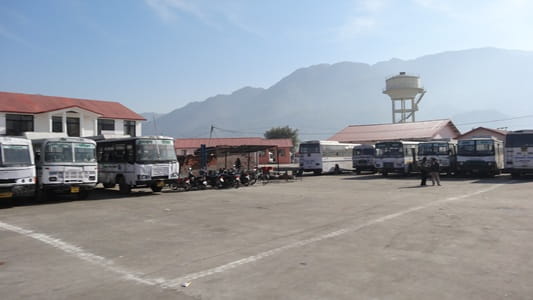
Rishikesh Bus Station Overview
| Detail | Information |
| Name | Rishikesh Inter State Bus Terminus (ISBT) |
| Location | ISBT Road, Adarsh Gram, Rishikesh, Uttarakhand — 249201 |
| Operated By | Uttarakhand Transport Corporation (UTC); State RTCs of Delhi, Haryana, HP, Chandigarh, Punjab |
| Distance from Natraj Chowk | Approx. 1 km |
| Distance from Rishikesh Railway Station | Approx. 2 km |
| Distance from Laxman Jhula | Approx. 5–6 km |
| Distance from Haridwar | Approx. 24 km |
| Distance from Dehradun | Approx. 42 km |
| Distance from Delhi | Approx. 240 km |
| Distance from Jolly Grant Airport | Approx. 18–20 km |
| Key Routes | Delhi, Haridwar, Dehradun, Chandigarh, Jaipur, Joshimath, Srinagar (Garhwal), McLeod Ganj, Agra |
| Special Facility | Char Dham Yatra Registration (Badrinath, Kedarnath, Gangotri, Yamunotri) |
| Bus Types | Ordinary, AC, Volvo (for plains routes) |
| Note on Volvo | Volvo buses available only for plains routes; hilly terrain roads restrict heavy vehicles |
| Secondary Bus Stand | Private Tehri Bus Stand — hill station routes; Nepali Farm — many private operators |
| Operating Hours | 24 hours |
Location
The ISBT is in Adarsh Gram near the Chandrabhaga Bridge — a locality that sits on the western approach to central Rishikesh. The location is accessible from the main highway without entering the older, more congested parts of the city, which makes arrival and departure smoother than the narrow lanes of the Ram Jhula and Laxman Jhula zones would allow for buses. The mountain views from the bus stand’s open areas are genuinely good — a spatial quality that few Indian urban bus terminals can claim.
Directions
From Rishikesh Railway Station, auto-rickshaws, e-rickshaws, and shared autos cover the 2-kilometre distance in 10 to 15 minutes. From Jolly Grant Airport, travel northward via the connecting road approximately 18 to 20 kilometres, 35 to 50 minutes by cab. From Delhi via the highway corridor, the stand is approximately 240 kilometres, 5 to 7 hours — significantly longer during Char Dham season when traffic on NH-58 between Haridwar and Rishikesh becomes severely congested.
Connectivity
Rishikesh Railway Station — 2 kilometres away — provides rail connectivity though service frequency is limited. The city does not have metro rail, and the mountain terrain makes future metro development unlikely. UTC buses, shared autos, e-rickshaws, and app-based cabs cover local movement. The Haridwar bus frequency is the most practically useful — services run throughout the day covering the 24-kilometre corridor in 45 to 60 minutes, giving Rishikesh residents and visitors seamless access to Haridwar’s broader rail and bus network.
Nearby Areas
Triveni Ghat: The most sacred bathing ghat in Rishikesh and the site of the daily Ganga aarti is approximately 2 to 3 kilometres from the ISBT, accessible by e-rickshaw. AIIMS Rishikesh: The All India Institute of Medical Sciences campus draws patients from across Uttarakhand and the neighboring hill states, generating significant healthcare visitor traffic through this bus terminal. Ram Jhula and Laxman Jhula: The iconic Ganga suspension bridges and the ashram belt along the western bank draw international spiritual tourists — accessible from the ISBT via shared autos.
Frequently Asked Questions (FAQs)
Q1. Where is Rishikesh Bus Station located?
A: ISBT Road, Adarsh Gram — approximately 1 km from Natraj Chowk and 2 km from Rishikesh Railway Station.
Q2. Are there two bus stations in Rishikesh?
A: Yes — the main ISBT for plains and intercity routes, the Private Tehri Bus Stand for hill station routes, and the Nepali Farm circle which many private operators use as their primary Rishikesh stop.
Q3. Can I register for Char Dham Yatra at Rishikesh Bus Station?
A: Yes — the ISBT has a dedicated Char Dham Yatra registration facility covering Badrinath, Kedarnath, Gangotri, and Yamunotri.
Q4. Are Volvo buses available from Rishikesh ISBT?
A: Yes, for plains routes including Delhi and Haridwar. Volvo buses are not available for hill routes due to narrow road constraints.
Q5. How far is Rishikesh Bus Station from Delhi?
A: Approximately 240 km, taking 5 to 7 hours depending on traffic — longer during Char Dham pilgrimage season.